
SAWP Canada: Seasonal Farm Worker Program Guide
SAWP Canada is a government-to-government farm work program for citizens of Mexico and 11 Caribbean countries, offering up to 8 months of seasonal work between January 1 and December 15. Workers are recruited by their own governments, never by private agents. This guide explains who qualifies, how the program works, and how to spot scams that misuse its name.
Key Takeaways
– SAWP covers citizens of Mexico and 11 Caribbean countries only: Anguilla, Antigua and Barbuda, Barbados, Dominica, Grenada, Jamaica, Montserrat, St. Kitts-Nevis, St. Lucia, St. Vincent and the Grenadines, and Trinidad and Tobago.
– Employment lasts a maximum of 8 months, between January 1 and December 15, and the employer must offer at least 240 hours of work within 6 weeks or less.
– Workers are recruited and selected by their own governments under bilateral agreements with Canada. Private agents do not recruit for SAWP.
– Employers need a positive Labour Market Impact Assessment (LMIA), must pay at least the highest of the provincial minimum wage, the prevailing wage, and the rate paid to Canadians in the same job, and must provide housing and cover transportation under the program rules.
– If you are not a citizen of a participating country and someone is selling you a SAWP place, it is not a genuine offer.
SAWP Canada: what the program is
The Seasonal Agricultural Worker Program is a government-to-government program that lets Canadian farm employers hire temporary foreign workers from Mexico and participating Caribbean countries for seasonal agricultural work, when Canadians and permanent residents are not available. The program operates under bilateral agreements between Canada and each participating country, and it sits inside the Temporary Foreign Worker Program, which means the employer needs a Labour Market Impact Assessment. It is one of Canada’s oldest labour mobility programs, running since the 1960s, and it is built around a simple idea: the worker’s own government does the recruiting, so no private middleman stands between the worker and the job.
Three facts define the program’s shape. First, the country list is closed: Mexico plus the 11 Caribbean countries named above. No other nationality can use SAWP, and no employer can sponsor a SAWP worker from outside the list. Second, the season is capped: a maximum of 8 months, and all work must fall between January 1 and December 15 of the same year. Third, the hours are guaranteed at a floor: the employer must be able to offer at least 240 hours of work within a period of 6 weeks or less. That floor exists so a worker who travels across the world for the season is not left with a few hours a week.
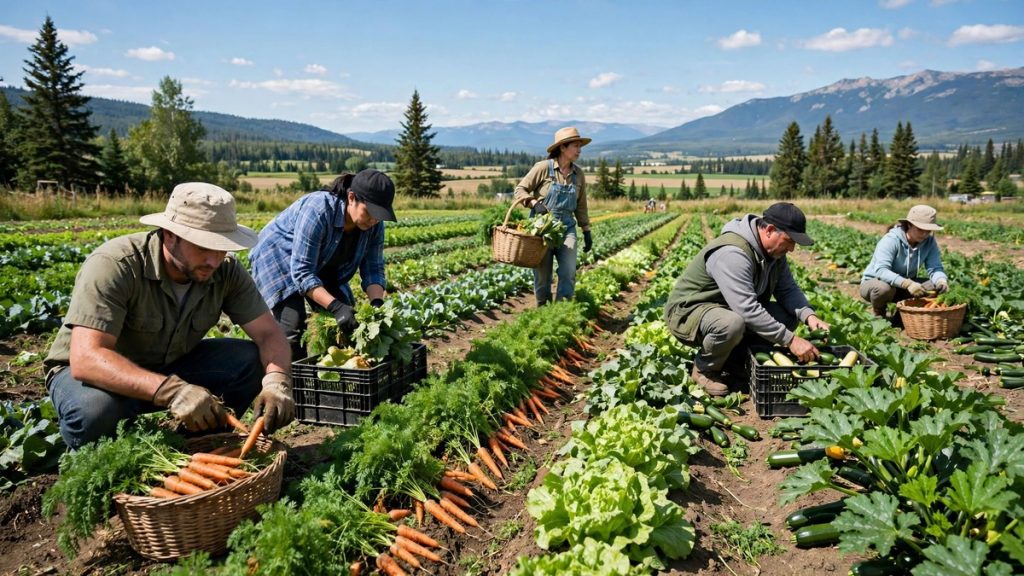
The work itself must be on-farm primary agriculture in specific commodity sectors. The national commodity list covers apiary products, bovine, dairy, duck, flowers, fruits and vegetables (including canning and processing of products grown on the farm), grains, oil seeds and seed corn, horse, maple syrup, mink, mushrooms, nursery-grown trees including Christmas trees and greenhouse operations, pedigreed canola seed, poultry, sheep, sod, swine, and tobacco. Food processing off the farm, landscaping, and other non-farm work do not qualify under SAWP — those jobs fall under other streams with different rules.
Who qualifies, and how recruitment works
To be eligible for a work permit under SAWP, you must be a citizen of a participating country, be at least 18 years old, be experienced in farming, and satisfy Canadian immigration law and the laws of your home country. The participating governments recruit and select the workers, make sure they have the necessary documents, maintain a pool of qualified workers, and appoint representatives to assist workers in Canada. In practice, that means you apply through your own country’s labour ministry or SAWP liaison office — in Mexico, through the national employment service; in Jamaica and the other Caribbean countries, through the ministry responsible for labour. The process, the waiting lists, and the selection criteria are set by your government, not by Canada and not by any agent.
That government-to-government structure is also the program’s main protection against fraud. Nobody can sell you a SAWP place, because places are not sold — they are allocated through government selection. If someone on social media, WhatsApp, or a website offers you a SAWP job for a fee, a “processing charge,” or a payment for documents, it is a scam. Real SAWP recruitment charges the worker nothing. The same warning applies to anyone claiming to be a “SAWP agent” with employer connections: the program has no agents. If you are unsure whether an offer is genuine, contact your country’s labour ministry or SAWP liaison office directly and ask.
Employers must meet three criteria to hire through SAWP: the workers must be citizens of Mexico or a participating Caribbean country, production must be in a specific commodity sector, and the activity must be related to on-farm primary agriculture. The employer applies for an LMIA from Employment and Social Development Canada, and only with a positive LMIA can the worker apply for a work permit. Our guides to LMIA jobs in Canada and farm jobs in Canada explain the LMIA process and the wider farm-job landscape in detail.
Wages, housing, transport, and your rights
Under the program rules, the employer must pay at least the highest of three figures: the provincial or territorial minimum wage, the prevailing wage ESDC sets for the occupation and region, and the rate the employer pays Canadian workers in the same job. That “highest of” rule is the wage protection built into the program, and it means your pay cannot legally sit below what a Canadian doing the same work earns at the same farm. Pay is weekly, and the employment contract you sign before travelling states the wage, the hours, the deductions, and the working conditions. Read that contract carefully, keep a copy, and ask your government representative about anything you do not understand before you board the plane.
Employers must provide housing under the program rules, and must cover transportation costs as set out in the employment contract and program requirements. Housing must meet provincial standards, and the details — what is provided, what deductions apply, and what happens at the end of the season — are in the contract. If housing is deducted from your pay, the deduction amount must be stated in the contract. Never accept a verbal promise about housing or transport in place of a written contract term.
Workers under SAWP hold the same workplace protections as Canadian workers: provincial employment standards, occupational health and safety rules, and access to health care and workers’ compensation coverage as provided by the province. Each participating country appoints representatives — liaison officers or consular staff — to assist workers in Canada. If you have a problem with pay, housing, safety, or treatment, contact your government representative, and you can also contact ESDC’s tip line for temporary foreign worker abuse. You do not need your employer’s permission to seek help, and an employer cannot punish you for doing so. Our guide to work permits vs job offers explains how the permit, the LMIA, and the job offer fit together.
Transfers, returning seasons, and the Agricultural Stream
SAWP workers can move to another SAWP employer in Canada, but the move is controlled: it needs your consent, written approval from your government’s representative and from ESDC/Service Canada, and a positive LMIA for the new farm. Do not simply walk off one farm and start at another — an unapproved move can breach your work permit conditions. Talk to your government representative first, and get the approvals in writing.
Many SAWP workers return for season after season, often to the same farm, and employers frequently request the same workers back. That returning-worker pattern is a normal, expected feature of the program, and it is arranged through the same government channels as the first season. Other seasonal industries hire on a similar returning-worker pattern — see our guides to fish plant jobs in Nova Scotia and Banff hospitality seasonal jobs — but a move between programs still needs the approvals described above. Returning does not change the rules: each season needs a positive LMIA, a valid work permit, and a signed contract, and each season ends by December 15.
If you are not a citizen of a participating country, SAWP is closed to you — but the Agricultural Stream is a separate route under the Temporary Foreign Worker Program that is open to workers from any country and allows longer employment periods. The Agricultural Stream covers the same on-farm primary agriculture work, also requires an LMIA, and has its own employer requirements. Do not let anyone sell you a “SAWP” place if your country is not on the list; ask instead whether the Agricultural Stream fits your situation, and read the official ESDC pages for both programs before you commit to anything.
Frequently Asked Questions
Which countries can use the Seasonal Agricultural Worker Program?
Mexico and 11 Caribbean countries: Anguilla, Antigua and Barbuda, Barbados, Dominica, Grenada, Jamaica, Montserrat, St. Kitts-Nevis, St. Lucia, St. Vincent and the Grenadines, and Trinidad and Tobago. If you are a citizen of another country, SAWP does not apply to you — the Agricultural Stream is the separate route open to workers from any country.
How long can SAWP workers stay in Canada?
A maximum of 8 months, with all work falling between January 1 and December 15 of the same year. The employer must offer at least 240 hours of work within 6 weeks or less. Each season needs a positive LMIA, a valid work permit, and a signed employment contract, and workers return home by December 15.
How do I apply for SAWP?
Through your own government, not through an agent. Participating governments recruit and select workers, check documents, and maintain pools of qualified workers. Contact your country’s labour ministry or SAWP liaison office to learn the local process. Nobody can sell you a SAWP place — any offer that asks for a fee is a scam.
What wage do SAWP workers earn?
The employer must pay at least the highest of the provincial minimum wage, the ESDC prevailing wage for the occupation and region, and the rate paid to Canadian workers in the same job at the same farm. The wage, hours, deductions, and conditions are stated in the employment contract you sign before travelling. Keep a copy of the contract and ask your government representative about anything unclear.
Sources
- Employment and Social Development Canada, Hire a temporary worker through the Seasonal Agricultural Worker Program — Overview: https://www.canada.ca/en/employment-social-development/services/foreign-workers/agricultural/seasonal-agricultural.html
- Immigration, Refugees and Citizenship Canada, Seasonal Agricultural Worker Program (operational bulletin): https://www.canada.ca/en/immigration-refugees-citizenship/corporate/publications-manuals/operational-bulletins-manuals/temporary-residents/foreign-workers/sawp.html
- Immigration, Refugees and Citizenship Canada, You need an LMIA to get a work permit: https://www.canada.ca/en/immigration-refugees-citizenship/services/work-canada/permit/temporary/need-permit/lmia.html
Never pay anyone for a job, LMIA or a visa. Real Canadian employers never charge workers a fee.



Leave a Reply
You must be logged in to post a comment.