
Farm Jobs in Canada With LMIA: How to Apply
Farm jobs in Canada with LMIA cover general farm work, harvesting, greenhouse labour, and livestock care, hired through two main federal routes: the agricultural stream, open to workers from any country, and the Seasonal Agricultural Worker Program, limited to Mexico and participating Caribbean countries. This guide explains both routes, the seasons, the pay Job Bank lists, and how to apply.
Key Takeaways
– Two routes exist: the agricultural stream (any country) and SAWP (Mexico and 11 Caribbean countries only).
– SAWP work runs up to 8 months, between January 1 and December 15, with at least 240 hours offered within 6 weeks.
– Job Bank lists a national median wage of $19.00 an hour for harvesting labourers (NOC 85101). Wages vary by province and commodity.
– The LMIA fee does not apply to most primary agriculture roles, and workers never pay it anyway.
– Seasonal roles fill months ahead. Start your Job Bank search well before the season you want.
The roles: what farm work actually looks like
Farm work in Canada is not one job. The posting titles vary, and the duties vary with them, so read each posting rather than assuming you know the role from the title alone.
General farm workers handle the daily work of a farm: feeding and tending animals, cleaning barns and pens, operating basic farm equipment, repairing fences, and helping with planting and harvest as the season demands. On a mixed farm, one week can look nothing like the next. On a specialized operation, the work repeats daily, and speed and consistency matter more than variety.
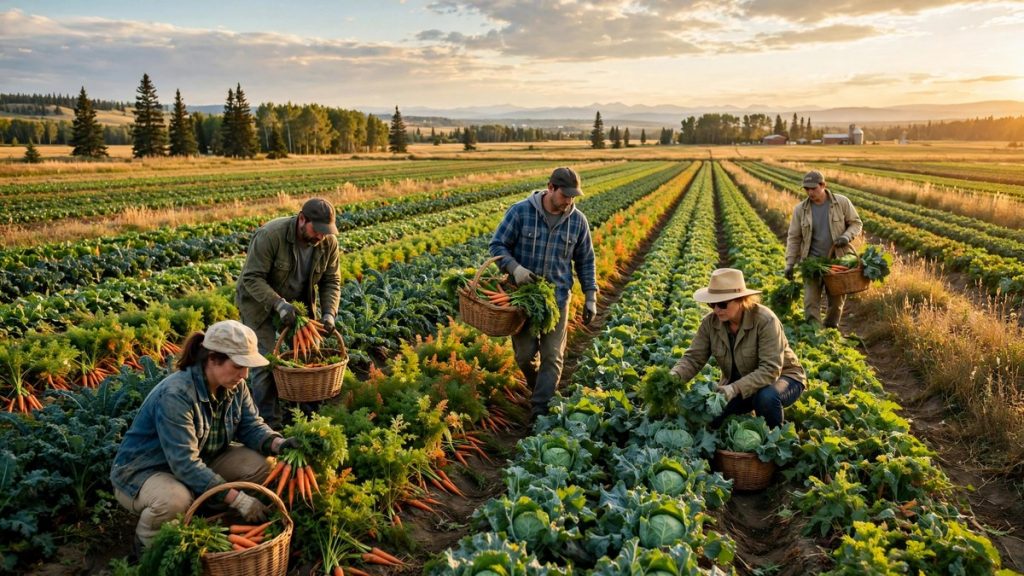
Harvesting labourers (NOC 85101 on Job Bank) pick, sort, grade, and pack crops. Fruit and vegetable farms hire the largest numbers during harvest, and the work is physical: bending, lifting, and long days outdoors in whatever weather the week brings. Job Bank notes that harvesting labourers usually work more than 40 hours a week during peak season, which matches what the postings show. If you have never done piece-rate or fast-paced outdoor labour, be honest with yourself about the pace before you apply.
Greenhouse and nursery workers plant, water, prune, and move plants, prepare soil and growing media, and pack product for shipment. Greenhouse work runs year-round in many operations, which makes it one of the steadiest farm options. The trade-off is heat and humidity inside the greenhouse in summer, and early starts in every season.
Livestock workers feed animals, monitor health, clean facilities, assist with birthing in some operations, and keep records of feed and treatments. Livestock work does not stop for weekends or holidays, so schedules often include rotation through weekends. Experience with animals helps, but many postings offer on-the-job training for the right candidate.
What do employers ask for? Many labourer postings list no formal education requirement and no prior farm experience, with training provided on the job. What they do ask for is physical fitness, reliability, and the ability to work outdoors in all conditions. A driver’s licence helps on rural farms where public transit does not exist, and some postings list it as a requirement. Read the “requirements” section of each posting, because a posting that wants equipment experience will say so, and applying without it wastes everyone’s time.
Where the work is, and when
Farm work follows the growing season, and Canada’s seasons are short and sharp. Planting runs through spring, crop care through summer, and harvest from late summer into fall. Greenhouse, mushroom, and livestock operations run all year, but even they hire heaviest in spring.
Ontario holds a large share of the postings, with fruit and vegetable farms in the southwest, greenhouses around Leamington and the Niagara region, and livestock across the province. British Columbia’s Okanagan Valley and Fraser Valley, Alberta’s grain and livestock country, Saskatchewan and Manitoba’s grain belt, and Quebec’s farms all show up regularly on Job Bank. The Atlantic provinces add potato, blueberry, and seafood-adjacent farm work in season.
Does that mean you should pick a province first? Not quite. Pick the crop and the season first, then the province follows. Berry harvest in BC peaks in summer. Greenhouse work in Ontario hires year-round. Grain harvest on the Prairies is a short, intense window in late summer and early fall. If you search Job Bank in November for a July berry job, you will find little. Search in February and March, and the same occupation shows a different picture. Seasonal hiring runs months ahead of the season itself, so timing your search matters as much as the search terms.
Rural living is part of the deal for most farm roles. Farms sit outside towns, shifts start early, and a car or employer-arranged transport is often the only way in. Ask about housing and transport before you accept. Some employers provide housing on or near the farm, and the terms should be written in your employment agreement, including any cost. If housing is not mentioned anywhere, ask. Arriving in a rural area with no place to stay and no transport is a problem you do not want to solve after a long flight. The first 30 days guide covers the practical steps after arrival, including the first housing and transport decisions.
Farm jobs in Canada with LMIA: the two routes
This is the part most guides blur, and it decides whether you can even apply. Two federal routes cover most farm hiring from abroad, and they are not interchangeable.
The agricultural stream: open to workers from any country
The agricultural stream sits inside the Temporary Foreign Worker Program and covers on-farm primary agriculture roles where production is on the National Commodities List. Any nationality can be hired through it, for seasonal or full-year work. The employer applies for an LMIA, and the LMIA processing fee does not apply to the listed primary agriculture occupations, including general farm workers and harvesting labourers.
For LMIAs processed in October 2026, ESDC’s average processing time for the agricultural stream was 20 business days. That is far quicker than the high-wage and low-wage streams, but it still sits on top of recruitment time before the application and work permit processing after it. Plan in months, not weeks.
SAWP: Mexico and participating Caribbean countries only
The Seasonal Agricultural Worker Program (SAWP) is a bilateral program that lets Canadian farm employers hire seasonal workers from Mexico and 11 participating Caribbean countries for up to 8 months at a time. The participating Caribbean countries are Anguilla, Antigua and Barbuda, Barbados, Dominica, Grenada, Jamaica, Montserrat, St. Kitts-Nevis, St. Lucia, St. Vincent and the Grenadines, and Trinidad and Tobago.
SAWP has rules that set it apart from the agricultural stream. Workers must be citizens of a participating country, at least 18 years old, experienced in farming, and selected by their own government. Your government recruits you; you do not apply to a Canadian farm directly under SAWP. The work period runs between January 1 and December 15, and the employer must offer at least 240 hours of work within 6 weeks or less. SAWP uses a standard employment contract, and the employer’s LMIA still has to be approved. For LMIAs processed in October 2026, SAWP averaged 11 business days, the fastest stream ESDC reports.
If you are not a citizen of a participating country, SAWP is not your route, and no agent can change that. Your route is the agricultural stream, through a Job Bank posting and an employer LMIA. The full SAWP guide covers the program in detail, including how government selection works in each country.
Which route should you pursue?
Ask one question: are you a citizen of Mexico or one of the 11 Caribbean countries listed above? If yes, check both routes, and start with your government’s SAWP liaison office, since SAWP selection runs through government channels. If no, focus on the agricultural stream and Job Bank postings with an LMIA status. Either way, the LMIA complete guide explains the shared steps: employer recruitment, LMIA decision, then your work permit application.
Pay: what Job Bank lists, and what varies
Farm pay is listed plainly on Job Bank, and the numbers are modest. Job Bank’s wage data puts the national median wage for harvesting labourers (NOC 85101) at $19.00 an hour. That is a national median, not a promise. Provincial medians differ, and the wage in any single posting is the wage that matters for that job.
Several things move the number. Province and commodity matter: the same harvesting role can list different wages in Ontario, Alberta, and Saskatchewan. Experience and equipment skills matter: a worker who can operate machinery earns more than a first-season labourer. Hours matter most of all. A $19-an-hour role at 60 hours a week in peak season pays very differently from the same rate at 35 hours in a slow month, and overtime rules vary by province and by whether the role is covered by provincial employment standards exemptions for farm work. Ask how overtime is handled before you accept, and get the answer in writing.
Some postings describe pay by output rather than by the hour. If you see that, ask how the rate works, what a typical day produces, and whether a minimum hourly guarantee applies. Do not accept a pay structure you cannot explain back in your own words.
One more check: compare the posting wage with the Job Bank wage tool for the same occupation and region. A posting far below the local median is a warning sign. A posting far above it is also worth a second look, since scam postings often dangle high pay. The wage tool is free, and the check takes two minutes.
How to apply, step by step
1. Search Job Bank’s temporary foreign worker listings
Use the dedicated search for temporary foreign workers and the LMIA status filter, as described in the Job Bank search guide. Search by occupation title and province. “General farm worker,” “harvesting labourer,” and “greenhouse worker” are the titles that return the most results. Filter for approved LMIAs if you want the shortest path, and include requested LMIAs if you can wait.
2. Read the whole posting
Check the duties, the wage and hours, the location, the start date, and the “advertised until” date. Seasonal postings often list a start date months out, and applying early is normal. If the posting says the employer will provide housing, note the terms. If it says nothing about housing or transport, plan to ask.
3. Apply as the posting directs
Follow the application instructions exactly. Some employers want a resume by email. Others use an online form. A short, honest resume works best: your farm experience, the crops or animals you have handled, any equipment you can operate, and your availability dates. Do not invent experience. Farm employers spot it fast, and a bad first week ends the job anyway.
4. Ask the LMIA questions early
In your first exchange with the employer, ask whether an LMIA has been approved or only requested, which stream it falls under, and what the timeline looks like. If the employer cannot answer, or asks you to pay any fee, stop. The LMIA fee does not apply to most primary agriculture roles, and no fee of any kind is ever charged to the worker.
5. Get the agreement in writing
Before you apply for a work permit, you should hold a signed employment agreement that matches the posting: same job, same wage, same hours, same location. Keep copies of everything: the posting, your application, the agreement, and the LMIA letter the employer sends you. These papers are your record if anything changes after you arrive.
A note on agents and “farm job packages”
Farm jobs attract more middlemen than almost any other occupation, and most of them add nothing. A legitimate employer hires through Job Bank or its own careers page and charges the worker nothing. An agent who offers a “guaranteed farm job package” for thousands of dollars, sight unseen, is selling you a Job Bank search you can run yourself, or selling you nothing at all.
There is one narrow exception worth knowing. In SAWP countries, government liaison offices and authorized bodies handle selection, and that channel is official. Outside that channel, be sceptical of anyone who claims a special relationship with Canadian farms. Ask for the employer’s name, the Job Bank posting number, and the LMIA status, and verify all three yourself. If the agent cannot provide them, you have your answer. The job scams guide lists the warning signs that apply to every occupation, including farm work.
Frequently Asked Questions
Can I get a farm job in Canada with an LMIA if I am not from Mexico or the Caribbean?
Yes, through the agricultural stream, which is open to workers from any country for on-farm primary agriculture roles. SAWP is the route limited to Mexico and participating Caribbean countries. If you are outside those countries, search Job Bank’s temporary foreign worker listings for farm postings with an LMIA status, and apply directly as the posting directs.
How long does a farm LMIA take?
For LMIAs processed in October 2026, ESDC reported an average of 20 business days for the agricultural stream and 11 business days for SAWP, counted from the day a complete application is submitted. Those are averages and they change monthly. Add the employer’s recruitment period before the application and your work permit processing after the decision, and plan your timeline in months.
Do farm workers have to pay the LMIA fee?
No. The LMIA processing fee does not apply to most primary agriculture occupations, and in every stream the fee is the employer’s cost and cannot be charged to or recovered from the worker. If anyone asks you to pay for an LMIA, a job offer, or recruitment for a farm job, it is a scam. Keep the messages and report it.
Is farm work in Canada seasonal or year-round?
Both. Field crop work follows the growing season, with planting in spring and harvest from late summer into fall, while greenhouse, mushroom, and livestock operations often run year-round. SAWP work is seasonal by design, capped at 8 months between January 1 and December 15. The agricultural stream covers seasonal and full-year roles. Check the posting for the start date and duration before you apply.
Sources
- Employment and Social Development Canada, hire a temporary foreign agricultural worker: https://www.canada.ca/en/employment-social-development/services/foreign-workers/agricultural.html
- Employment and Social Development Canada, Seasonal Agricultural Worker Program overview: https://www.canada.ca/en/employment-social-development/services/foreign-workers/agricultural/seasonal-agricultural.html
- Employment and Social Development Canada, SAWP program requirements: https://www.canada.ca/en/employment-social-development/services/foreign-workers/agricultural/seasonal-agricultural/requirements.html
- Immigration, Refugees and Citizenship Canada, SAWP eligibility: https://www.canada.ca/en/immigration-refugees-citizenship/services/work-canada/special-instructions/agricultural/seasonal-agricultural/eligibility.html
- Employment and Social Development Canada, LMIA application processing times: https://www.canada.ca/en/employment-social-development/services/foreign-workers/labour-market-impact-assessment-processing-times.html
- Government of Canada Job Bank, search for temporary foreign workers: https://www.jobbank.gc.ca/jobsearch/jobsearch?d=50&sort=M&page=1&fsrc=32
Never pay anyone for a job, LMIA or a visa. Real Canadian employers never charge workers a fee.




[…] area, and DFO sets and adjusts them. Farm work follows the same seasonal rhythm, and our guide to farm jobs in Canada covers how those seasons and LMIA routes work. What I can tell you, from Job Bank postings, is the […]