
Fish Plant Jobs in Nova Scotia: What to Know
Fish plant jobs Nova Scotia employers post through Job Bank cover cutting, cleaning, packing and machine work in seafood processing plants along the coast. The median wage was $17.00 an hour in the province, and Job Bank rates prospects as good — but the work is cold, wet, physical and seasonal, so read this guide before you apply.
Key Takeaways
– Fish and seafood plant workers (NOC 94142) set up and operate machinery to process and package fish and seafood products, and do hands-on cutting, cleaning and trimming.
– Job Bank lists the Nova Scotia median wage at $17.00 an hour, with a low of $17.00 and a high of $20.00, based on 2024–2025 data updated in November 2026.
– Job Bank rates job prospects as good in Nova Scotia and in the Southern Region, where the median wage is $17.50 an hour.
– Plants are licensed and inspected by the province. Processing covers filleting, icing, packing, canning, freezing, smoking, salting, cooking, pickling and drying.
– Hours follow the catch. Postings list 30 to 60 hours a week, with overtime, weekend work and shift work. Confirm the schedule, the season length, and housing before you move for a job.
Fish plant jobs Nova Scotia: what the work actually is
A fish plant worker is a worker who prepares fish and seafood for sale by cutting, cleaning, trimming, sorting, weighing, packing and operating processing machines in a licensed plant. Job Bank puts the occupation under NOC 94142, fish and seafood plant workers, and describes the core of the job as setting up and operating machinery to process and package fish and seafood products. The hands-on tasks in live postings add the detail: cut, clean and trim fish or seafood before marketing or further processing; cut and weigh fillets to specification; sort and grade product; pack boxes; and keep the line moving.
The province’s own definition of processing is broader than most people expect. Nova Scotia’s Department of Fisheries and Aquaculture says processing means filleting, icing, packing, canning, freezing, smoking, salting, cooking, pickling, drying, or preparing fish or seafood for market in any other manner. A plant that only ices and packs whole fish is a processing plant. So is a plant that cooks, picks and cans lobster meat. The job title on the posting — fish plant worker, seafood processing worker, fish cutter, packer — tells you less than the task list does. Read the tasks.
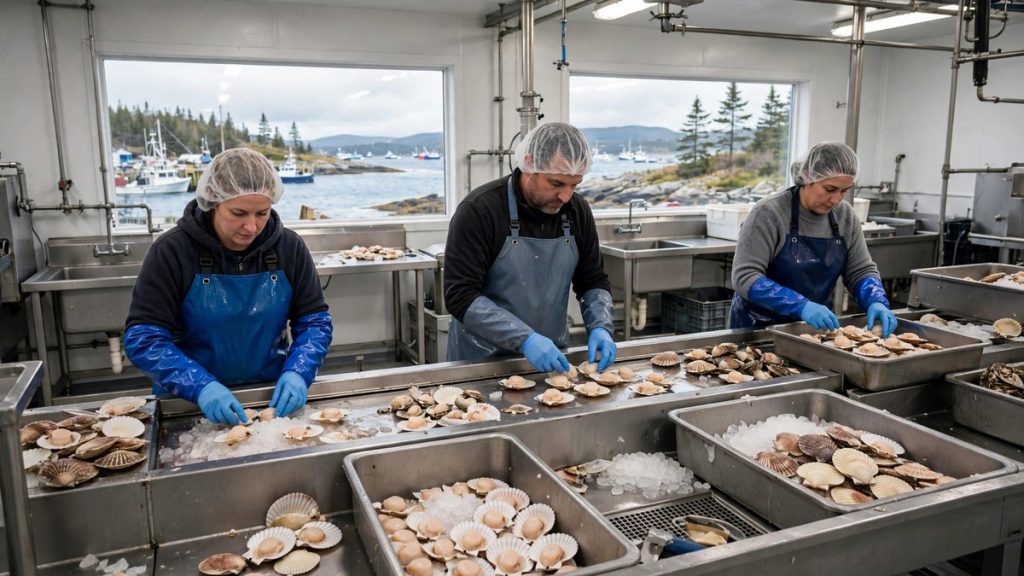
A typical shift looks like this. You arrive, put on protective clothing — apron, gloves, hairnet, boots — and wash your hands. You take a station on a line: a table, a conveyor, or a machine. Fish or shellfish comes to you on ice or in totes, and you cut, clean, sort, weigh or pack it to the plant’s specification. Supervisors check quality and speed. Breaks are scheduled. The floor is cold, wet and noisy, and you stand for most of the shift. At the end of the day, the line is cleaned down, and the next crew takes over.
Where the plants are
Seafood processing in Nova Scotia is a coastal industry in small communities, not a Halifax office-park industry. The province’s Seafood Sector Strategy 2026–2029 describes the sector as the core economic engine for the province, supporting thousands of jobs and anchoring coastal and rural livelihoods and communities. That language matches what Job Bank postings show: plants in small towns and villages along the coast, often the largest employer in the community.
Job Bank’s market reports break Nova Scotia into regions, and wage and outlook data is published for the province as a whole and for the Southern Region, Cape Breton Region, North Shore Region, and Annapolis Valley Region. The Southern Region, which covers the south shore and southwest, shows the highest regional median wage for this occupation at $17.50 an hour. Cape Breton shows $17.00, and the North Shore shows $17.00. Those regional numbers tell you the work is spread across the province, not packed into one city.
That geography shapes the whole job decision. A plant job in a town of 800 people is a different life from a warehouse job in Halifax. There may be one grocery store, limited rental housing, and no bus. Some postings mention help with housing or a willingness to relocate; others say nothing, and you are on your own. Before you apply for a plant job in a community you have never visited, ask three questions: where will I live, how will I get to the plant, and what happens when the season ends? An employer with a real hiring need will answer all three.
Seasons, wages, and what postings really promise
Seafood processing follows the catch, and the catch follows seasons, weather, and quotas. That is the single most important thing to understand about these jobs, and it is also the thing most online ads gloss over. A plant that runs 60 hours a week in a busy stretch may run 30 hours, or shut a line down, when landings drop.
I will not give you a calendar of season dates for a specific plant, because that would be guessing. Seasons differ by species — lobster, scallop, snow crab, groundfish, salmon — and by fishing area, and DFO sets and adjusts them. Farm work follows the same seasonal rhythm, and our guide to farm jobs in Canada covers how those seasons and LMIA routes work. What I can tell you, from Job Bank postings, is the shape of the work: postings list 30 to 60 hours a week, with day, evening and weekend shifts, overtime required, and overtime available. Some postings list 60 vacancies at one plant. That pattern — large numbers, long hours, a defined start — is the signature of seasonal hiring.
On wages, Job Bank publishes data for fish and seafood plant workers from Employment Insurance survey data, with a reference period of 2024–2025, updated on 18 November 2026. For Nova Scotia, the low wage is $17.00 an hour, the median is $17.00, and the high is $20.00. For Canada as a whole, the low is $16.00, the median is $17.85, and the high is $20.35. The Southern Region shows a median of $17.50 and a high of $21.00. A median of $17.00 means half of workers in the survey data earned more and half earned less. It is not a promise. Your actual wage is the number on your offer letter, and postings vary. Two Job Bank postings from October 2026 illustrate the range: one in Lower L’Ardoise listed $17.00 to $17.50 an hour, to be negotiated, for 30 to 60 hours a week; one in North Wallace listed $17.00 an hour for 30 hours a week. Both have since closed — I cite them as examples of how postings state pay, not as live jobs.
Requirements and how to apply
Most fish plant postings ask for little in the way of formal education. Job Bank postings for this occupation commonly list no degree, no diploma, or a secondary school diploma as an asset rather than a requirement. What plants do ask for, consistently, is reliability, physical stamina, and the ability to stand, bend, lift and repeat the same motions for a full shift. Postings describe the work site environment in plain terms: noisy, odours, cold and refrigerated, wet and damp. That description is honest. If you have never worked in a cold, wet room for eight hours, try to picture it before you commit to moving across the province for the job.
Food safety matters: plants are licensed and inspected facilities, and workers follow hygiene rules — hand washing, protective clothing, hairnets, and no jewellery on the line. A food handler certificate is not always required, but it never hurts. Most postings are in English, and you need enough English to follow safety instructions and communicate with a supervisor. Safety instructions are not the place for guesswork.
Work authorization is the line that decides everything for a newcomer. Some Job Bank postings for this occupation note that an LMIA was requested — meaning the employer applied to hire a temporary foreign worker because it could not find a Canadian worker. Others do not. An LMIA note on one posting says nothing about the next posting. Never assume a plant job comes with sponsorship or a work permit. Read the posting, ask the employer directly, and read our guide to LMIA jobs in Canada before you pay anyone or sign anything. If you are already authorized to work in Canada, say so clearly in your application — it removes the employer’s biggest question in one line.
Start on Job Bank, not on social media. Search “fish plant worker” or “seafood processing” with Nova Scotia as the location, and read the full posting: tasks, wage, hours, location, start date, and how to apply. Our guide to searching and applying on Job Bank shows how to use the filters and save searches. Set up an alert so new postings reach you the day they appear — seasonal hiring moves fast. Apply the way the posting says to apply, with a one-page resume: your name, phone, email, the physical work you have done, any food or factory experience, and your availability. If a posting lists a phone number, calling can help — plants hire people, not paper.
Do not apply through middlemen who charge a fee. Real Nova Scotia plants post on Job Bank and on their own sites, and they do not charge applicants. If a social media ad promises a fish plant job with a high wage, free housing, and a visa, and asks for money up front or for your passport details by chat, treat it as a scam until proven otherwise. Our guide to job scams in Canada lists the warning signs in detail.
Housing, transport, and the off-season
Housing is the hardest part of a fish plant job for someone coming from outside the community. Small coastal towns have limited rentals, and a plant hiring 60 people at once can swamp the local market. Some employers offer staff housing or help finding rooms. Some do not. Ask before you accept, and get the answer in writing: is housing provided, what does it cost, who else lives there, and what happens at the end of the season? If housing is deducted from your pay, ask for the deduction amount in writing too.
Transport is the second question. Most plants are not on a bus route. You need a car, a ride from a coworker, or housing within walking distance. If you do not drive, say so in the interview and ask how other workers get there. Some plants run a shuttle or help coordinate rides. Some do not, and a job you cannot reach is not a job.
The off-season is the third question, and the one newcomers most often forget. When the season ends, the hours end. Some workers collect Employment Insurance between seasons. Some move to other seasonal work, such as Banff hospitality seasonal jobs, which hire in waves before the winter and summer peaks. Some plants keep a smaller year-round crew, and performance decides who stays. Ask the employer what the off-season looks like, and plan your money for the slow months. A season that pays well for four months and nothing for two is still a good deal if you plan for it, and a bad surprise if you do not.
Frequently Asked Questions
What is the wage for fish plant jobs in Nova Scotia?
Job Bank lists the Nova Scotia median wage for fish and seafood plant workers at $17.00 an hour, with a low of $17.00 and a high of $20.00, based on 2024–2025 survey data updated in November 2026. The Southern Region median is higher, at $17.50 an hour. Individual postings vary — recent Job Bank postings listed $17.00 to $17.50 an hour — so the wage on the live posting and on your offer letter is the number that counts. Check the Job Bank wage tool for the current figures before you accept an offer.
Do fish plant jobs in Nova Scotia need experience?
Many postings ask for no formal education and no prior experience, and say training is provided. What matters more is physical stamina, reliability, and the ability to follow food safety and hygiene rules in a cold, wet plant. Knife skills, food processing experience, or a food handler certificate can help you get hired faster and start on a better station, but they are not always required. Read the task list on each posting, because “fish plant worker” covers several different stations.
Are fish plant jobs in Nova Scotia seasonal?
Often, yes. Hours follow the catch, and postings list 30 to 60 hours a week with overtime and weekend work. Seasons vary by species and fishing area, and DFO sets the fishing seasons while the province licenses the plants. Before you accept a job, ask the employer for the expected start and end dates, the expected hours in a busy week and a slow week, and whether the role is permanent or seasonal. Plan your money for the off-season, and ask about recall for the next season.
Can newcomers or temporary foreign workers get fish plant jobs in Nova Scotia?
Some Job Bank postings for this occupation note that an LMIA was requested, which means the employer applied to hire a temporary foreign worker. Others do not, and an LMIA note on one posting says nothing about the next one. Never assume sponsorship. Read the posting, ask the employer directly about work authorization, and never pay anyone for a job offer, an LMIA, or a visa. If you are already authorized to work in Canada, state that clearly in your application.
Sources
- Job Bank, Fish Plant Worker in Nova Scotia, summary and prospects: https://www.jobbank.gc.ca/marketreport/summary-occupation/18417/NS
- Job Bank, Fish Plant Worker in Nova Scotia, wages: https://www.jobbank.gc.ca/marketreport/wages-occupation/18417/NS
- Government of Nova Scotia, commercial fisheries FAQ (role of the province, definition of processing): https://novascotia.ca/fish/commercial-fisheries/faq/
- Government of Nova Scotia, fish buyers and fish processors licensing: https://novascotia.ca/fish/commercial-fisheries/licensing-leasing/
- Government of Nova Scotia, Seafood Sector Strategy 2026–2029 overview: https://novascotia.ca/seafood-sector-strategy/docs/seafood-sector-strategy-overview.pdf
Never pay anyone for a job, LMIA or a visa. Real Canadian employers never charge workers a fee.




Leave a Reply
You must be logged in to post a comment.