
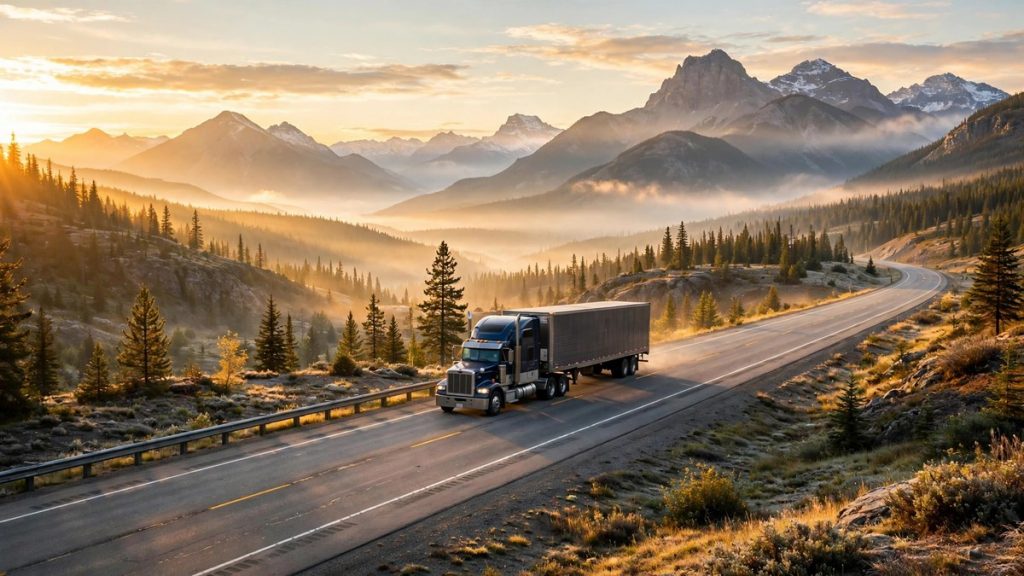
Truck Driver Jobs in Canada With LMIA
Truck driver jobs Canada LMIA postings cover long-haul tractor-trailer work and local delivery driving, and they hinge on holding the right licence. Ontario calls it Class A, usually with a Z air brake endorsement; Alberta and British Columbia call it Class 1. Each province sets its own training rules. Here is how licences, pay, and the LMIA route fit together.
Key Takeaways
– Ontario’s tractor-trailer licence is Class A, with AZ meaning Class A plus the Z air brake endorsement.
– Alberta and BC use Class 1. Alberta’s Class 1 Learning Pathway replaced MELT in April 2025; BC’s Class 1 MELT course is 140 hours.
– Job Bank lists a national median wage of $27.97 an hour for transport truck drivers (NOC 73300), with a low of $20.00 and a high of $38.46.
– An LMIA-based work permit names one employer. You cannot switch carriers without a new LMIA and a new permit.
– Get the licence picture clear before you chase postings. Training rules differ by province and foreign experience may not count.
Long-haul vs local: two different lives
The job title says “truck driver” in both cases. The daily reality splits in two, and the split should drive your choice more than the headline pay.
Long-haul drivers run tractor-trailers between cities and across provinces, sometimes across the border into the United States. Trips last days, not hours. You sleep in the cab or in paid accommodation, eat on the road, and come home on a rotation that might be weekly, or longer. The work suits people who like solitude and long stretches of focus. It strains family life and sleep, and winter driving on prairie and mountain highways is a skill in itself.
Local and regional drivers run shorter routes and sleep at home most nights: city delivery, regional runs out and back in a day, and specialized work like dump trucks, concrete mixers, and waste collection. The vehicle may be a straight truck rather than a tractor-trailer, which can mean a different licence class. Days are shorter but denser: city traffic, tight delivery points, more stops per shift.
Pay structures differ too. Some roles pay hourly; some long-haul roles pay by the mile or by the trip. A posting should say which, and if it does not, ask. A per-mile rate that looks generous can pay poorly on weeks with short runs, border delays, or uncounted waiting time at loading docks. Ask how waiting, loading, and layovers are treated, and get the answer in the agreement.
Be honest about home time. Drivers who take long-haul work for the pay and then hate the weeks away rarely last, and leaving early can complicate an LMIA-based permit. If you need to be home nightly, filter for local roles and accept different pay and licence requirements.
Licence classes by province: get this right first
Canada has no national truck licence. Each province licenses its own drivers, and the class names differ. An Ontario AZ and an Alberta Class 1 cover similar vehicles but are different licences under different rules, and moving provinces means dealing with licence exchange rules that vary. Here are the three provinces job seekers ask about most.
Ontario: Class A, and AZ for air brakes
A full Class A licence covers any truck and tractor-trailer combination, including combinations where towed vehicles exceed 4,600 kg in total gross weight. Add the Z air brake endorsement and you have the “AZ” Ontario postings ask for. The Z endorsement is its own program: driving a vehicle with air brakes or air-over-hydraulic brakes in Ontario requires it on your licence.
New Class A applicants must complete approved mandatory entry-level training (MELT) before the road test: at least 103.5 hours mixing classroom, in-yard, and on-road training, from an approved provider such as a registered career college. From January 1, 2027, drivers taking the Class A road test must have held a Class G or higher licence for at least 6 months. Check the current Ontario page before booking training.
Ontario also has Class D for straight trucks over 11,000 kg gross weight, where the towed vehicle does not exceed 4,600 kg. Many local jobs need only a Class D, sometimes with Z. Do not pay for Class A training if the jobs you want ask only for Class D. Match the licence to the postings.
Alberta: Class 1 and the Learning Pathway
Alberta’s tractor-trailer licence is Class 1, covering any motor vehicle other than a motorcycle. Upgrading requires a full Class 5 licence, a minimum age of 18, and a medical report.
Alberta replaced Class 1 MELT with the Class 1 Learning Pathway on April 1, 2025. The pathway starts with a 40-hour Entry program, then a Core Learning program focused on in-cab and in-yard instruction. Passing the knowledge and road tests after Core earns a provincially restricted Class 1 licence, valid within Alberta only; further competence-building training removes the restriction. Alberta also caps Class 1 training fees: $10,000 minimum and $12,000 maximum for students enrolling on or after April 1, 2026. That is the provider’s charge, not a government fee.
If you hold a Class 1-equivalent licence from another Canadian jurisdiction, Alberta may let you exchange it without the full pathway, depending on jurisdiction and experience. Drivers with 24 or more months of Class 1 experience from some jurisdictions can obtain an Alberta Class 1 without training or testing. Check the current list rather than assuming your licence transfers.
British Columbia: Class 1 and 140 hours of MELT
BC’s tractor-trailer licence is also Class 1, administered through ICBC. Since October 18, 2021, new Class 1 applicants must complete an ICBC-approved Mandatory Entry-Level Training course before the road test: 140 hours, including air brake training and six hours of mandatory flexible practical training, split between theory and practical yard and highway work. Students must finish within 12 months of enrolment.
BC’s stance on foreign experience is strict. If you hold or have held a Class 1 licence from outside Canada, expect the full MELT course, with no credit for training done abroad. Budget the time and cost into your first months; a decade of driving elsewhere does not shorten the course.
Other provinces
Outside Ontario, the tractor-trailer licence is usually called Class 1, and most provinces run their own version of mandatory entry-level training with different hour requirements. Check the licensing authority where you plan to live before enrolling in any course or accepting any job. A course bought in the wrong province is an expensive mistake.
Truck driver jobs Canada LMIA: how the hiring route works
An LMIA-based trucking job means the carrier applied to Service Canada for permission to hire a foreign driver, and a positive LMIA lets you apply for an employer-specific work permit tied to that carrier. The employer drives the process. You cannot apply for the LMIA, and you cannot pay for it.
The sequence follows the standard LMIA path: local recruitment first, application through LMIA Online with the $1,000 fee per position, a decision, then the positive letter and signed contract to the driver, who applies to IRCC. The full steps are in the LMIA complete guide, and work permit vs job offer explains why the offer alone never lets you start work.
Two trucking-specific points matter. First, the stream depends on the wage: roles at or above the provincial median fall in the high-wage stream, which averaged 102 business days for LMIAs processed in October 2026, while lower-paid roles fall in the low-wage stream, averaging 86. Either way the wait is measured in months, and the positive LMIA is valid for up to 6 months, so the permit application must follow promptly.
Second, licensing and the LMIA interact. A carrier hiring through an LMIA needs a driver who can legally drive on the start date. If you hold no Canadian licence yet, ask how the carrier handles it: arrive already licensed, training support after arrival, and what happens to your start date if training runs long. Get answers before signing; a permit tied to an employer you cannot yet drive for helps no one.
Pay: Job Bank numbers, with context
Job Bank’s wage data for transport truck drivers (NOC 73300) shows a national picture of $20.00 an hour at the low end, a median of $27.97, and $38.46 at the high end. Those figures were updated on November 18, 2026, with a reference period of 2024–2025, drawn from Statistics Canada’s Labour Force Survey. Regional figures differ: Ontario showed a median of $27.00, Saskatchewan showed $28.00, and Nova Scotia showed $25.00.
Use those numbers as a benchmark, not a promise. Actual pay depends on carrier, route type, pay structure, and experience. A new local driver and a ten-year long-haul driver sit at different points in that range, and both are real. The benchmark is a smell test: an offer far below $20.00 for full-time tractor-trailer work in a major city should raise questions, as should one far above $38.46 with no experience requirement.
Hours and extras move the total too: overtime, night and weekend premiums, border-crossing pay, and benefits vary by carrier and by whether federal or provincial labour rules apply. Long-haul drivers under federal jurisdiction follow federal hours-of-service rules limiting driving time and mandating rest. If a carrier hints logbook rules are flexible, walk away. Your licence, and other people’s lives, ride on them being followed.
What employers ask for
Beyond the licence, carriers commonly want a clean driving abstract, a medical fitness report, and a criminal record check. Cross-border carriers also need drivers admissible to the United States, a separate check with its own paperwork. Experience requirements vary: some carriers hire newly licensed drivers with a mentor, others ask for a year or two on the road. Read each posting.
English or French communication matters more than some drivers expect: dispatchers, shippers, receivers, border officers, and inspectors, often by phone and under time pressure. If your language skills are shaky, working on them before arrival pays off faster than almost any other preparation.
Keep your driving record clean in every country you have driven in. Carriers and insurers check abstracts, and a serious violation can end a hiring process that survived everything else. If you have a past violation, say so early. Discovering it late wastes the carrier’s LMIA effort and your months of waiting.
How to apply
Start with Job Bank’s search for temporary foreign workers, using the LMIA status filter as the Job Bank search guide describes. Search “transport truck driver” and “truck driver” separately, and try “long haul truck driver” and “delivery driver” as well, since postings use all of these. The delivery driver guide covers the smaller-vehicle roles that need only a regular car licence.
On each posting, check the licence class, the wage and pay structure, the route type, and the “advertised until” date. Apply as directed, with a resume listing licence classes, endorsements, driving experience by vehicle type and region, and border-crossing experience. Be specific: “4 years, tractor-trailer, highway freight” tells a carrier more than “experienced driver.”
Ask the LMIA questions in your first exchange: approved or requested, which stream, and the timeline. Ask about licensing support if you lack the Canadian class, and get the pay structure in writing: hourly or per-mile, how waiting time is treated, and what a typical week looks like. A carrier that answers plainly is a good sign. One that dodges is not.
Red flags specific to trucking
Watch for “lease-operator” offers asking you to lease a truck from the carrier or a related company before one paid mile, especially with payments deducted from your pay. Some lease arrangements suit experienced owner-operators, but a newcomer on an employer-specific permit should not sign one without independent advice.
Watch also for training schemes charging large upfront fees with a “guaranteed job” attached, and carriers asking you to pay for the LMIA, the work permit, or recruitment. The LMIA fee is the employer’s, and recruitment fees cannot be charged to the worker. If an offer depends on you paying beyond your own government and licensing costs, it is not real as presented.
Finally, be careful with social media job posts that use a real carrier’s name and logo but a personal email address. Apply through Job Bank or the carrier’s own careers page, and confirm any offer by calling a number from the carrier’s official site. The job scams guide covers the general warning signs that apply to every occupation.
Frequently Asked Questions
What licence do I need to drive a truck in Canada?
It depends on the province and the vehicle. Ontario uses Class A for tractor-trailers, with the Z endorsement for air brakes, making AZ the common requirement. Alberta and British Columbia use Class 1 for tractor-trailers. Straight trucks over a set weight may need only a Class D in Ontario or a Class 3 in other provinces. Check the licensing authority in the province where you plan to live, and match your training to the postings you want.
Can I drive a truck in Canada with a foreign licence?
Not directly for employment. Each province sets its own exchange rules, and commercial classes usually require Canadian training and testing. In BC, new Class 1 applicants must complete the full 140-hour MELT course even with foreign experience. In Alberta, exchange without the full pathway applies to some Canadian licences, not foreign ones in the same way. Check the provincial authority before assuming anything transfers.
How long does a trucking LMIA take?
It depends on the stream, which depends on the wage. For October 2026, ESDC reported averages of 102 business days for high-wage and 86 for low-wage. Add recruitment time before the application and permit processing after it. A positive LMIA is valid for up to 6 months, so apply promptly once the decision arrives.
Do truck drivers get paid by the hour or by the mile in Canada?
Both exist. Local and regional roles usually pay hourly, while many long-haul roles pay by the mile or by the trip. Job Bank’s wage data is expressed hourly: a national median of $27.97 an hour for transport truck drivers. Whichever structure a posting uses, ask how waiting time, loading time, and layovers are paid, and get the pay terms in your written agreement before you accept.
Sources
- Government of Ontario, get a truck driver’s licence: https://www.ontario.ca/page/get-truck-drivers-licence
- Government of Alberta, obtaining a commercial licence: https://www.alberta.ca/upgrade-commercial-licence
- Government of Alberta, Class 1 Learning Pathway: https://www.alberta.ca/class-1-learning-pathway
- Insurance Corporation of British Columbia, Mandatory Entry Level Training FAQs: https://www.icbc.com/assets/en/7iiwc0XuKFVu86iODrPsJb/melt-faqs.pdf
- Government of Canada Job Bank, wages for transport truck drivers: https://www.jobbank.gc.ca/marketreport/wages-occupation/296484/22446
- Employment and Social Development Canada, LMIA application processing times: https://www.canada.ca/en/employment-social-development/services/foreign-workers/labour-market-impact-assessment-processing-times.html
- Government of Canada Job Bank, search for temporary foreign workers: https://www.jobbank.gc.ca/jobsearch/jobsearch?d=50&sort=M&page=1&fsrc=32
Never pay anyone for a job, LMIA or a visa. Real Canadian employers never charge workers a fee.




Leave a Reply
You must be logged in to post a comment.