
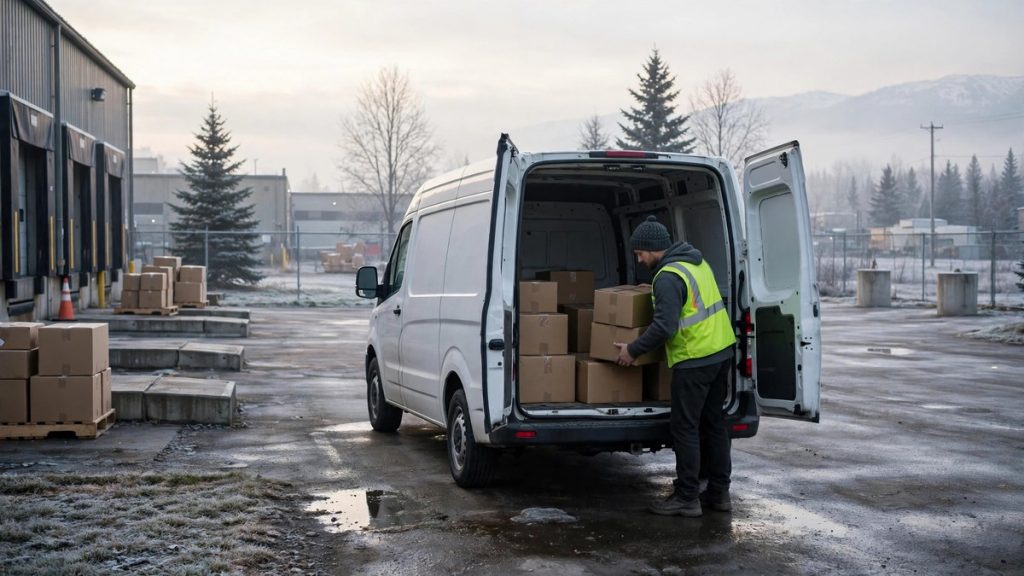
Delivery Driver Jobs in Canada: Licences & Pay
Delivery driver jobs Canada employers post cover parcels, food, groceries, and freight, in cars, vans, and light trucks, on local routes. The national median wage is $20.00 an hour, and most roles need only a standard driver’s licence and a clean record. This guide covers licences, pay, gig versus employed work, and how to apply.
Key Takeaways
– Job Bank lists delivery service drivers under NOC 75201, with a national median wage of $20.00 an hour (low $15.28, high $31.25, 2024–2025 data updated November 2026).
– A standard car licence covers cars and light vans in most provinces. Heavier trucks need a higher licence class — check your province’s licensing rules for the vehicle you will drive.
– Employed drivers get a wage, scheduled shifts, and usually benefits. App-based gig drivers are paid per delivery and cover their own vehicle costs — read the terms before you sign up.
– Tell your auto insurer you deliver for work. A personal policy may not cover commercial driving, and an undeclared accident can leave you uninsured.
– Apply through Job Bank and employer careers pages. Never pay anyone for a delivery job, a route, or a vehicle “deposit.”
Delivery driver jobs Canada: what the work looks like
A delivery service driver drives an automobile, van, or light truck to pick up and deliver products — parcels, food, groceries, documents, or retail goods — on local routes, usually returning to the same depot or restaurant each day. Job Bank puts the occupation under NOC 75201, delivery service drivers and door-to-door distributors. The work splits into three broad kinds. Parcel and courier drivers run set routes for courier companies and postal services, with a scanner, a manifest, and a van full of stops. Food and grocery drivers run shorter trips, often through an app, picking up orders from restaurants or stores and dropping them at homes. The restaurant side of that work is covered in our guide to food counter attendant and kitchen helper jobs, which lists the kitchen and counter roles that prepare the orders drivers collect. Retail and trade drivers deliver goods for a store or supplier — appliances, building materials, auto parts — sometimes with loading and installation help at the door.
A typical parcel shift starts at the depot: load the van in stop order, scan everything out, and run the route. A food delivery shift starts when you log in: accept orders, pick up, deliver, repeat. Both kinds share the same core skills — safe driving, route sense, time management, and polite, brief customer contact. Both are physical in ways people underestimate: stairs, heavy parcels, and getting in and out of the vehicle 100 times a day. If you have a bad back or bad knees, ask about the heaviest items on the route before you accept the job.
Job Bank’s summary for the occupation notes that job prospects vary across Canada depending on the province or territory. That is worth taking seriously: delivery hiring is strong in large cities and their suburbs, thinner in small towns, and seasonal everywhere — parcel volumes spike from November through the holidays, and food delivery peaks on weekends and bad-weather evenings. If you need steady hours, an employed depot job beats gig work for predictability. If you need flexible hours around school or a second job, gig work fits better, with lower income certainty.
Licences: the right class for the vehicle
Most delivery jobs need only the standard car licence your province issues — Ontario’s G licence, British Columbia’s Class 5, Alberta’s Class 5, Quebec’s Class 5 — plus a clean or near-clean driving record. Employers check your driver’s abstract, the official record of tickets, collisions, and suspensions, and most set a limit on demerit points and recent offences. A recent impaired-driving conviction or a suspended licence will disqualify you at most employers. If your record has blemishes, order your own abstract first so you know what the employer will see.
Heavier vehicles need higher licence classes, and the classes differ by province. A straight truck or a larger delivery truck may need an Ontario D or DZ licence, a BC Class 3, or the equivalent elsewhere. Air-brake endorsement (Z in Ontario, for example) is required for vehicles fitted with air brakes. If a posting names a licence class, check your province’s licensing site for exactly what that class covers and how to upgrade — do not guess from the job title. Our guide to truck driver jobs in Canada covers the higher licence classes and the training behind them.
Newcomers with a foreign licence face a province-by-province patchwork. Some provinces exchange licences from certain countries directly; others require a road test, a knowledge test, or both, and some require you to start in the graduated system. Check your province’s licensing authority site before you assume your foreign licence transfers. Driving on a foreign licence is usually allowed only for a short period after arrival, and the rules differ by province and by licence country. Get the local licence sorted before you apply for driving jobs — an employer cannot put you on the road without it.
Pay: what Job Bank says, and what gig work pays
Job Bank’s wage report for delivery service drivers and door-to-door distributors, updated 18 November 2026 with 2024–2025 Labour Force Survey data, lists a national low of $15.28, a median of $20.00, and a high of $31.25 an hour. Provincial medians: Ontario $20.00, British Columbia $21.00, Quebec $20.00, and Yukon $26.25. A median of $20.00 means half of workers in the survey earned more and half earned less — it is a benchmark, not a promise. Your actual wage is the number on your offer letter, and it varies by employer, vehicle, route, shift, and whether you are an employee or a contractor.
Employed drivers are usually paid hourly, with overtime rules set by provincial employment standards, and many receive non-wage benefits. Gig and app-based drivers are usually paid per delivery, plus tips where the app allows them, and they cover their own fuel, maintenance, insurance, and phone costs. That cost side matters: a gig driver earning $25 an hour before costs, driving 30 km an hour in city traffic, can net far less after fuel, wear, and insurance. Track every kilometre and every expense from day one — you will need the records for taxes, and they tell you whether the work actually pays.
One provincial rule deserves attention. British Columbia sets a minimum pay standard for app-based delivery and ride-hail workers, covering engaged time plus a per-kilometre amount. The rate is adjusted from time to time, so check the current figure on the BC government site rather than trusting a number in any guide. No other province had an equivalent standard at the time of writing, which means gig pay elsewhere is set entirely by the app’s terms. Read those terms before your first delivery, including how tips are handled, how deactivation works, and what happens if an order is cancelled mid-route.
Insurance: the detail that ruins drivers who skip it
Your personal auto insurance policy is written for personal driving. Delivery driving is commercial use, and most personal policies exclude it or limit it. If you deliver on a personal policy and have a collision during a delivery, your insurer can deny the claim — leaving you to pay for damage to your vehicle, the other vehicle, and any injuries. Tell your insurer you deliver for work and ask what coverage you need. The extra premium is real money, but it is a fraction of one uninsured collision.
Employed drivers driving a company vehicle are usually covered by the employer’s fleet policy while on the job — confirm that in writing before your first shift, and ask what happens if you use your own vehicle for any part of the route. Gig drivers need to check two things: what the app’s insurance covers (most apps provide some coverage during active deliveries, with gaps between trips) and what your own policy covers in the gaps. Get both answers in writing. “The app covers me” is not a coverage plan until you have read the policy.
How to apply, and what to watch for
Start on Job Bank, searching “delivery driver” or “courier” with your city, and read the full posting: vehicle type, licence class, hours, pay structure, and whether you use your own vehicle. Our guide to searching and applying on Job Bank shows the filters. Then check employer careers pages directly: courier companies, postal services, grocery chains, and retailers with delivery fleets all post on their own sites. Purolator posts sorter, courier, and driver helper roles through its careers search, and Canada Post hires online only — it does not take walk-in applications. Warehouse employers also hire drivers for their own fleets; our guide to Amazon warehouse jobs explains how that company’s hiring works, including its delivery station roles, and our guide to warehouse associate jobs covers the depot roles drivers work alongside.
Apply with a one-page resume naming your licence class, your driving record in one line (“clean abstract, 5 years licensed”), and any delivery or customer-service experience with numbers: stops per shift, parcels per day, on-time rate if you know it. If a posting asks for a driver’s abstract, order it before you apply so the application is not delayed.
Watch for scams. A real delivery job never asks you to pay for a route, a vehicle deposit, a uniform fee, or a background check as a condition of hiring. Ads promising $40 an hour with no experience, a free vehicle, and a visa, sent through WhatsApp with a Gmail address, are scams until proven otherwise. Verify the employer on its own careers page, and never hand over your passport, bank details, or SIN to someone who contacts you by message before an interview.
Frequently Asked Questions
What licence do I need for delivery driver jobs in Canada?
Most roles need only your province’s standard car licence — Ontario G, BC Class 5, Alberta Class 5, Quebec Class 5 — plus a clean driving record. Heavier trucks need higher classes and sometimes an air-brake endorsement. Check your province’s licensing site for the exact class the posting names, and sort out any foreign-licence exchange before you apply.
How much do delivery drivers earn in Canada?
Job Bank lists a national median of $20.00 an hour for delivery service drivers (low $15.28, high $31.25), based on 2024–2025 data updated in November 2026. Employed drivers earn hourly wages with benefits at many employers. Gig drivers are paid per delivery plus tips and cover their own vehicle costs, so net earnings depend heavily on fuel, distance, and expenses.
Is delivery driving gig work or employment in Canada?
Both exist. Employed drivers work scheduled shifts for one employer, earn an hourly wage, and are usually covered by employment standards and the employer’s insurance. App-based drivers work when they choose, are paid per delivery, and are usually contractors covering their own costs. British Columbia sets a minimum pay standard for app-based delivery work; other provinces do not.
Do I need my own vehicle for delivery jobs in Canada?
It depends on the role. Parcel and courier companies usually provide the van. Food and grocery app work usually requires your own car, bike, or scooter, plus commercial-use insurance. Check the posting: if it says “own vehicle required,” factor fuel, maintenance, and insurance into whether the pay works for you.
Sources
- Job Bank, Wages for delivery service drivers and door-to-door distributors (NOC 75201): https://www.jobbank.gc.ca/wagereport/occupation/21684
- Job Bank, Delivery Driver in Canada, summary: https://www.jobbank.gc.ca/marketreport/summary-occupation/21667/ca
- Government of Canada, Job Bank: https://www.jobbank.gc.ca/
Never pay anyone for a job, LMIA or a visa. Real Canadian employers never charge workers a fee.




[…] to a DSP, not to Amazon directly, and the DSP sets your schedule, vehicle, and terms. Our guide to delivery driver jobs in Canada covers licences, pay, and insurance for driving work […]
[…] Mobile patrol needs a valid driver’s licence and a clean driving record — our guide to delivery driver jobs in Canada covers licence classes and driving-record checks that apply to patrol driving too. Each step […]