
Warehouse Associate Jobs in Canada: Pay & Duties
Warehouse associate jobs Canada employers post cover picking, packing, sorting, loading and moving goods in distribution centres and retail warehouses. Most ask for some secondary school and the strength for repeated lifting, with forklift training as a plus. The national median sits at $22.50 an hour for material handlers.
Key Takeaways
– Warehouse associates load, unload and move products by hand or with handling equipment, and count, weigh, sort, pack and unpack goods.
– Job Bank classifies this work under material handlers, NOC 75101, and reports a national median of $22.50 an hour for 2024-2025.
– Some secondary school education may be required, and physical strength is required for manual handlers working with heavy materials.
– In Ontario, a lifting device may be operated only by a competent person, so forklift training and a workplace evaluation matter more than any single card.
– Most large employers hire online, while some run advertised hiring events; never walk into a warehouse unannounced and expect an interview.
What a warehouse associate does on shift
A material handler handles, moves, loads and unloads materials by hand or with a range of handling equipment, working for transport, storage, manufacturing, retail and wholesale employers. “Warehouse associate” is the job title you see on postings. “Material handler” is the occupation name Job Bank and the National Occupational Classification use for the same family of work, under NOC 75101. The title on the posting and the code in the data describe the same job from two angles, so search both terms when you look for openings.
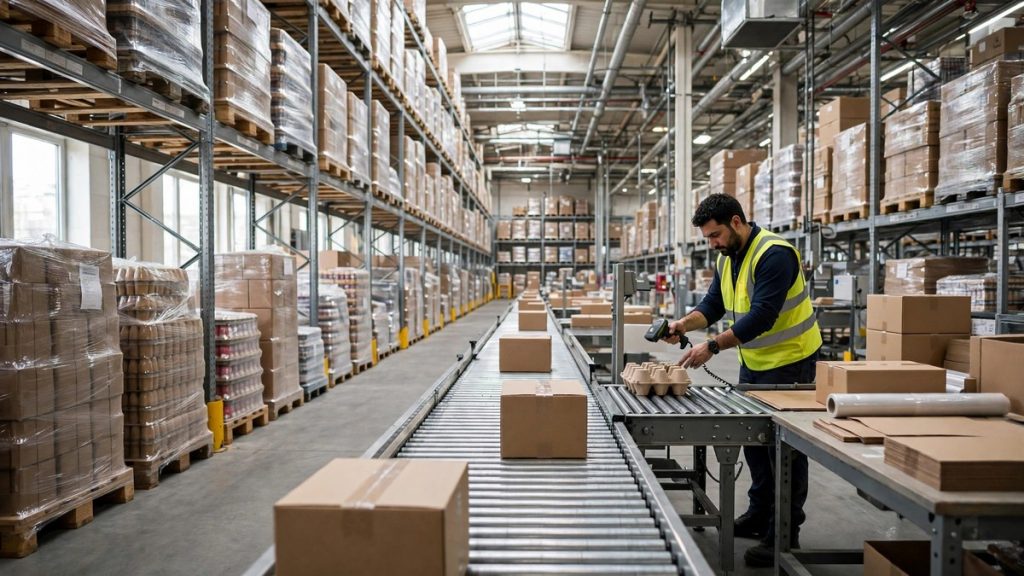
A typical shift runs through a short list of tasks, repeated at pace. You load and unload trucks and containers, move product to and from storage, and pick orders from racking. You count, weigh, sort, pack and unpack goods, scan cartons, label boxes and build pallets for shipping. In courier and parcel operations, you sort freight by destination, weight, size and shape to meet delivery schedules. In grocery distribution, you assemble cases of product on pallets for store orders, wrap the orders and prepare them for shipping. Loblaw’s warehouse assembler postings describe that grocery pattern, in a fast-paced unionized setting, with lifting and carrying of 50 pounds and more. Purolator’s frontline operations postings describe sorter work in similar terms: separating freight so it leaves on schedule.
Equipment changes the job. Some associates work mostly by hand with pallet jacks and carts. Others operate winches and loading devices, industrial trucks, tractors and loaders, or conveyors that move grain and other bulk goods. Forklift truck operator sits inside the same occupation group, and forklift work usually pays toward the upper part of the range because it carries added training and added risk. Job Bank notes that material handlers usually work 35 to 40 hours a week, though warehouse rosters often include afternoon, night and weekend shifts, and seasonal peaks can add overtime. Read the shift pattern on each posting before you apply, and be honest about the shifts you can sustain for months.
The work is physical in a way that surprises first-timers. Repetitive motion is the norm: the same lift, twist and reach, hundreds of times a shift. Cold storage roles add low temperatures and heavier clothing. Loading docks add trucks reversing, forklifts crossing and noise that makes shouted warnings hard to hear. Good boots, gloves that fit, and a habit of checking behind you before you step back are worth more than speed in your first week. Speed comes once the layout and the routine sit in muscle memory.
Warehouse associate jobs Canada: pay by province
Job Bank reports wages for material handlers under NOC 75101 from the Labour Force Survey, with a reference period of 2024-2025. The figures below come from the Job Bank wage page updated on 18 November 2026. They show wages actually paid to workers, not wages advertised in postings, and they do not include non-wage benefits. The median is the middle value when wages are ranked from lowest to highest, and the low and high figures correspond, in most cases, to the 10th and 90th percentiles.
| Area | Low | Median | High |
|---|---|---|---|
| Canada | $17.20 | $22.50 | $31.50 |
| Ontario | $17.95 | $22.40 | $30.00 |
| British Columbia | $18.25 | $22.95 | $35.36 |
| Alberta | $17.23 | $24.00 | $32.50 |
| Quebec | $17.35 | $22.60 | $31.95 |
At 40 hours a week, the national median of $22.50 an hour works out to $900 a week, or $46,800 a year before tax. Provincial medians sit close together, from $22.40 in Ontario to $24.00 in Alberta, so the province line alone tells you less than the employer, the shift and the equipment you run. Night shifts, cold storage and forklift roles often sit above the floor, while entry-level packing roles often sit near it. When you compare offers, weigh guaranteed hours, shift premiums, overtime rules and whether the job is permanent, seasonal or through an agency, because those details move yearly income more than a dollar on the hourly rate.
What you need to get hired
The formal bar is low, and the practical bar is about reliability and physical readiness. Some secondary school education may be required, and physical strength is required for manual material handlers who work with heavy materials. Training and experience operating a forklift are assets for certain positions. No university degree is involved. What hiring managers actually screen for is simpler: can you do the lifting, can you work the posted shifts, can you get to the site on time, and will you stay past the first month.
Forklift work deserves its own paragraph because the rules confuse people. Ontario has no single government forklift licence that covers every workplace. What the province requires is competence. Regulation 851 states that a lifting device is only to be operated by a competent person, and Ontario’s guideline for powered lift trucks sets out the knowledge and skills an operator should hold: how the truck works, the hazards of the work, and the operating procedures for the truck class assigned, from pre-operation checks through load handling and refuelling or recharging. The guideline also notes that the regulation does not say exactly how competence must be shown, which is why employers run their own training and evaluations on their own trucks.
A competent lift truck operator in Ontario knows the truck class assigned, understands the hazards of the work, and can run the truck in a way that protects the operator and everyone nearby. In practice that means a training course plus a supervised evaluation at the workplace, on the truck you will actually drive. A card from a course helps you get shortlisted, but it does not replace the employer’s own check, and a new employer will usually evaluate you again on its own equipment. If a posting names a specific truck class or attachment, say so in your application when you have it, and say plainly when you do not. Claiming forklift time you never had is a fast route to a failed evaluation and a lost offer.
Other tickets help in narrower cases. WHMIS training, first aid, and any ticket the posting names by name are worth holding before you apply. Keep copies of every certificate with expiry dates, because warehouses check them at hiring and again at renewal. If you have no warehouse history, name any physical or team work you have done: farm work, moving work, stock work, construction labour. Our guide to construction labourer jobs in Canada covers site work that builds the same habits hiring managers look for. The point is to show a hiring manager you know what a full shift of lifting feels like and you kept showing up.
How to find openings and apply
Job Bank comes first. Search “material handler,” “warehouse associate,” “order picker” and “forklift operator” with your city, sort by date posted, and read the “who can apply” section on each posting. Our guide to how to use Job Bank Canada covers the search filters and the alert setup. Set narrow alerts for the cities you can realistically commute to, and check them daily during a job search, because warehouse postings fill fast.
Employer careers pages come next. Loblaw’s supply chain careers page lists distribution centre roles by location, and its warehouse assembler postings spell out the lifting and shift expectations. Purolator’s frontline operations listings cover sorters, couriers and driver helpers by city. Amazon directs Canadian warehouse applicants to its hiring site rather than to walk-in events, and our guide to Amazon warehouse jobs in Canada explains that online route step by step. Check these pages weekly, and again before seasonal peaks, when hiring surges.
Hiring events are the third route, and they reward preparation. Some employers run advertised events at distribution centres or through staffing partners, with on-the-spot interviews. Our guide to warehouse walk-in interviews in Toronto and the GTA shows how those events work, what to bring, and which employers hire online only. The rule holds everywhere in Canada: attend only events advertised with a date, hours and address on an official source, and never walk into a working warehouse unannounced. Sites will turn you away at the gate and tell you to apply online.
At the interview, expect short screening questions: which shifts you can work, how you will get to the site for an early or late start, whether you can lift the posted weight repeatedly, and what warehouse or physical work you have done. Answer with specifics and real transport plans, not general promises. Ask about starting wage and raises, permanent or seasonal status, training length and whether it is paid, and how schedules are posted. If you receive a conditional offer, read the conditions and complete them the same day when you can.
Watch for scams that mimic warehouse hiring. Walk away if anyone asks you to pay for a job, a forklift card, an LMIA or a visa, or asks for payment by gift card, crypto or wire transfer to a personal account. Walk away if a “recruiter” offers a warehouse job you never applied for over WhatsApp or social media, with a well-known company name and a personal email address. Verify every offer against the employer’s own careers page before you share documents or money. Our guide to job scams in Canada lists the warning signs in full and where to report.
Frequently Asked Questions
Do I need experience to get a warehouse associate job in Canada?
Often no. Many picker, packer and sorter roles ask for little or no warehouse experience and train new hires on site, and the formal requirement is only that some secondary school education may be required. Name any physical or team work you have done, even outside warehousing, and be clear about the shifts and the lifting you can handle.
Do I need a forklift licence in Ontario?
Ontario does not issue one general forklift licence. Regulation 851 requires a lifting device to be operated only by a competent person, and employers train and evaluate operators on their own trucks. A forklift course helps you get shortlisted, but expect a workplace evaluation at each new employer, on the truck class you will drive there.
How much do warehouse associates earn in Canada?
Job Bank reports a national median of $22.50 an hour for material handlers in 2024-2025, with a range from $17.20 at the low end to $31.50 at the high end. Provincial medians run from $22.40 in Ontario to $24.00 in Alberta. Shift, equipment and employer move pay more than the province line alone.
Can I walk into a warehouse and ask for a job?
Not in any useful sense. Warehouses are secured industrial sites, and unannounced visitors are turned away at the gate and told to apply online. Walk-in interviews happen only at advertised hiring events with set hours. If no event is advertised, apply through Job Bank or the employer’s careers page.
Sources
- Government of Canada Job Bank, wages for material handlers (NOC 75101): https://www.jobbank.gc.ca/marketreport/wages-occupation/16666/ca
- Government of Canada Job Bank, job description for material handlers (NOC 75101): https://www.jobbank.gc.ca/marketreport/occupation/16653/BC
- Government of Canada Job Bank, wage methodology: https://www.jobbank.gc.ca/trend-analysis/search-wages/wage-methodology
- Government of Ontario, guideline for powered lift trucks, competency: https://www.ontario.ca/document/guideline-safe-operation-and-maintenance-powered-lift-trucks/competency
- Government of Ontario, guideline for powered lift trucks, safety program: https://www.ontario.ca/document/guideline-safe-operation-and-maintenance-powered-lift-trucks/safety-program
- Government of Canada Job Bank, find a job: https://www.jobbank.gc.ca/landing-intro-findajob.xhtml
- Loblaw, supply chain careers: https://careers.loblaw.ca/supply-chain/
- Loblaw, warehouse assembler posting: https://careers.loblaw.ca/warehouse-assembler/job/R2000534816
- Purolator, frontline operations jobs: https://careers.purolator.com/go/Frontline-Operations-jobs/1107600/
- Amazon Canada hiring: https://hiring.amazon.ca/
Never pay anyone for a job, LMIA or a visa. Real Canadian employers never charge workers a fee.




[…] service, warehousing, cleaning, delivery, security, and health-care support roles. Our guides to warehouse associate jobs and cleaner jobs cover two of the fastest entry points in detail. Managers in these sectors weigh […]