
Welder Jobs in Canada: Pay, Tickets & How to Apply
Welder jobs Canada employers post cover joining and cutting metal with arc, gas and resistance processes, in shops, shipyards and on construction and industrial sites. Training runs through a three-year apprenticeship or years of shop experience plus courses. The national median is $31 an hour, with Alberta highest at $39.
Key Takeaways
– Welders operate welding equipment to weld ferrous and non-ferrous metals, and the occupation also covers machine operators of preset production welding equipment.
– Job Bank tracks welders under NOC 72106, with a national median of $31.00 an hour for 2024-2025.
– Trade certification usually requires a three-year apprenticeship, or three or more years of experience plus some college or industry welding courses.
– Trade certification is compulsory in Alberta and voluntary in other provinces and territories, with a Red Seal endorsement available through the interprovincial exam.
– Postings name the exact process, position and ticket they want, so read those lines literally and apply only where your tickets match.
What welders do
A welder operates welding equipment to weld ferrous and non-ferrous metals, joining, shaping and repairing metal parts for structures, machinery, ships, boilers and other products. The occupation, NOC 72106, also covers welding, brazing and soldering machine operators who run preset production welding equipment. Both sides of the occupation live in the same data, the same shops and often the same posting, but the day differs: a welder reads drawings, sets up and runs the process by hand, while a machine operator sets and monitors preset equipment on a production line. Read the posting to see which side it sits on.
The processes form the vocabulary of every posting. Welders use gas tungsten arc welding, gas metal arc welding, flux-cored arc welding, plasma arc welding, shielded metal arc welding, oxy-acetylene welding, resistance welding and submerged arc welding. They cut with flame-cutting equipment, braze and solder, operate metal shaping machines such as brakes, shears and other metal straightening and bending machines, and repair worn parts of metal products by welding on extra layers. Each process suits different metals, thicknesses and positions, and employers hire for the process mix their work needs. A shop building structural steel wants different tickets from a shop repairing heavy equipment, and a pipeline contractor wants different tickets again.
The settings are just as varied. Welders work for companies that manufacture structural steel and platework, boilers, heavy machinery, aircraft and ships, and for welding contractors and welding shops, and some are self-employed. Shop work runs on regular hours with steady supervision. Field work runs on site schedules, weather and travel. Fabrication shops reward clean, repeatable welds at pace. Repair work rewards judgment: reading the damage, choosing the process, and laying down a weld that holds under load. Construction work adds heights, confined spaces and coordination with other trades, and our guide to construction labourer jobs in Canada describes the site conditions welders share with the rest of the crew.
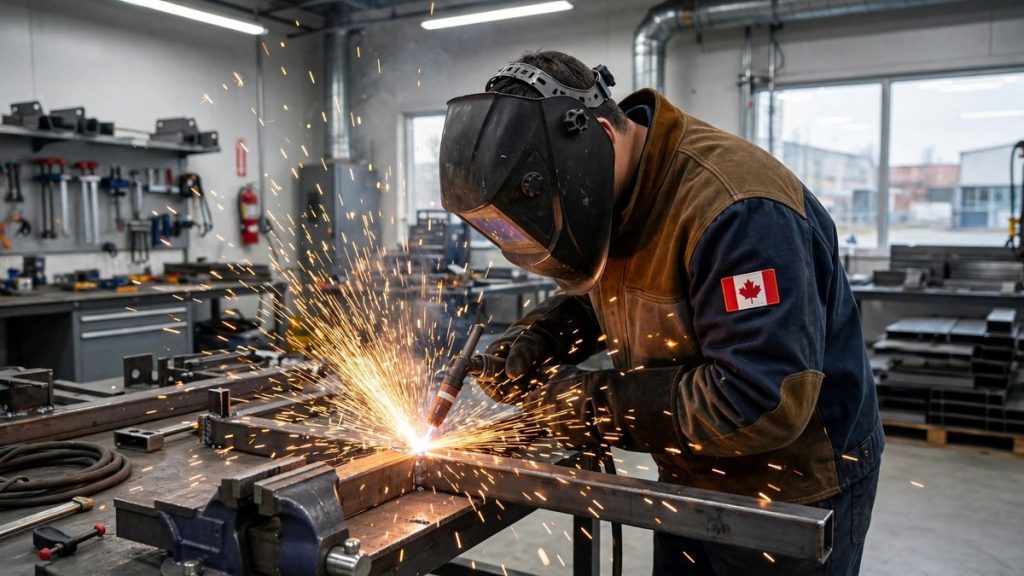
The physical side is demanding in a specific way. Welding runs hot, bright and loud. You wear a helmet, gloves, jacket and boots for the whole shift, work in awkward positions under and around metal, and hold a steady hand while the arc burns. Fumes, sparks and heavy plate are daily hazards, and the safety rules around ventilation, eye protection and hot work are not optional extras. A steady hand and patience under a helmet matter more than raw speed. A weld that looks fast and fails inspection costs the shop more than a slow weld that passes first time.
Welder jobs Canada: pay by province
Job Bank reports wages for welders and related machine operators under NOC 72106, with a reference period of 2024-2025. The figures come from the Labour Force Survey, except for Quebec, where the source is Employment Insurance Survey Data for the same period. The table below comes from the Job Bank wage page updated on 18 November 2026. The figures show wages actually paid to workers, not wages advertised in postings, and they do not include non-wage benefits. The median is the middle value when wages are ranked from lowest to highest, and the low and high figures correspond, in most cases, to the 10th and 90th percentiles.
| Area | Low | Median | High |
|---|---|---|---|
| Canada | $22.00 | $31.00 | $48.42 |
| Ontario | $20.00 | $28.78 | $45.00 |
| British Columbia | $23.25 | $37.30 | $54.00 |
| Alberta | $25.00 | $39.00 | $54.00 |
| Quebec | $23.03 | $29.00 | $36.16 |
At 40 hours a week, the national median of $31.00 an hour works out to $1,240 a week, or $64,480 a year before tax. Alberta shows the highest provincial median at $39.00, followed by British Columbia at $37.30, while Ontario sits at $28.78 and Quebec at $29.00. Alberta and British Columbia also show the widest spreads, reaching $54.00 at the high end. The spread reflects the mix of work: production machine operators and entry-level shop welders sit near the low end, while certified welders on specialized, high-pressure or field work sit near the high end. Overtime, shift premiums, travel allowances and per diems add to field income but do not appear in the hourly figures, so compare total packages, not just the rate.
Training, certification and the Red Seal
Entry usually starts with secondary school, which is usually required for the trade. From there, two routes lead to certification. The first is a three-year apprenticeship program, combining paid work with in-school training under a registered agreement. The second is three or more years of work experience in the trade plus some college or industry courses in welding. Both routes usually lead to trade certification, and the apprenticeship route is the cleaner path for anyone starting from zero, because it structures the hours, the schooling and the exam in one program. Our guide to electrician apprenticeship in Canada describes how apprenticeship agreements, sponsors and school blocks work in a trade with a similar shape.
Trade certification for welders is compulsory in Alberta and voluntary in other provinces and territories, and qualified welders can earn a Red Seal endorsement by passing the interprovincial Red Seal exam. The Alberta rule changes the plan for anyone working there: in Alberta you need the certification to practise the trade, while elsewhere employers may still ask for it even though the province does not require it. The Red Seal endorsement is a seal on your provincial or territorial trade certificate showing you have the knowledge and skills to practise your trade across Canada. Welder appears on the Red Seal trades list, and the endorsement is what carries your credential across provincial lines when work moves you.
Postings often name the exact process, position and ticket they want, and those lines deserve literal reading. A posting that asks for shielded metal arc welding in all positions wants proof of exactly that, and a posting that names a specific welding procedure or inspection standard wants the ticket that matches it. This guide does not list ticket codes, because the right ticket depends on the employer, the code the work is built to, and the province. Ask the employer which ticket the posting means, in writing, before paying for any test. Never pay a third party that promises to issue a welding ticket without a test, and never claim a process or position you have not passed. Weld tests at hiring expose the gap in minutes, and a failed test after a false claim ends the application.
Money help for apprentices has changed recently, so check current pages rather than old guides. The federal funding page lists the Apprenticeship Incentive Grant and the Apprenticeship Completion Grant as not accepting applications, and lists the Red Seal Completion Bonus, a $5,000 payment for eligible journeypersons who complete an apprenticeship and receive certification in a designated Red Seal trade. Applications for the bonus opened on 16 November 2026: if you were certified between 1 April 2025 and 15 November 2026, apply by 31 May 2027; if you are certified on or after 16 November 2026, apply within 12 months of your certification date. Confirm eligibility and the application route on canada.ca before counting on it, and never pay anyone who offers to apply for you.
How to apply
Job Bank comes first. Search “welder,” “welding,” and the process names you hold, such as “GMAW” or “SMAW,” with your city, and read the process, position and ticket lines on each posting. Our guide to how to use Job Bank Canada covers the search filters and alerts. Welding contractors and fabrication shops also hire directly, so check the careers pages of shops in your area and ask about upcoming work, because much hiring in this trade runs on reputation and referrals.
Your resume should list processes, positions and tickets by name, with the dates and the issuing body for each ticket, and name the metals and thicknesses you have worked with. Name the employers and the type of work: structural, pressure, repair, production. Keep the format clean and Canadian, and keep copies of every ticket with expiry dates, because shops check them at hiring and again at renewal. If your experience comes from outside Canada, name the processes and standards you worked to, and ask each employer how it assesses foreign experience and tickets before you pay for any Canadian test. Our guide to getting hired without Canadian experience shows how to present foreign experience without overstating it.
At the interview, expect a weld test. Shops test because the weld speaks for itself, and a clean test beats a long resume. Ask what the test covers, what position and process it uses, and whether it is paid. Ask about the shop’s work mix, the hours and overtime pattern, travel and per diem for field work, and how ticket renewals are handled and paid for. A shop that answers plainly and tests fairly is worth more than a higher rate at a shop that cuts corners on safety.
Watch for scams. Walk away if anyone asks you to pay for a welding job, a ticket, an LMIA or a visa. Walk away if an offer arrives with no interview, no weld test and no verifiable shop address. Verify every offer against the employer’s own listing or by calling the shop at a number you find yourself. Our guide to job scams in Canada lists the warning signs in full and where to report.
Frequently Asked Questions
Do I need an apprenticeship to become a welder in Canada?
Not always, but it is the cleanest route. Trade certification usually requires a three-year apprenticeship, or three or more years of work experience plus some college or industry welding courses. Secondary school education is usually required either way. Certification is compulsory in Alberta and voluntary elsewhere, though many employers ask for it regardless of province.
What is the Red Seal endorsement for welders?
The Red Seal endorsement is a seal on your provincial or territorial trade certificate showing you have the knowledge and skills to practise your trade across Canada, earned by passing the interprovincial Red Seal exam. Welder is a Red Seal trade. The endorsement is what lets a certified welder move between provinces without re-proving the trade from scratch.
How much do welders earn in Canada?
Job Bank reports a national median of $31.00 an hour for welders and related machine operators in 2024-2025, with a range from $22.00 at the low end to $48.42 at the high end. Provincial medians run from $28.78 in Ontario to $39.00 in Alberta. Specialized, high-pressure and field work sits near the high end, while production and entry-level shop work sits near the low end.
Which welding ticket do I need?
It depends on the employer, the process, the position and the code the work is built to, so there is no single ticket that covers every job. Read the posting’s process and ticket lines literally, and ask the employer which ticket it means before paying for any test. Never pay a third party that promises a ticket without a test.
Sources
- Government of Canada Job Bank, wages for welders and related machine operators (NOC 72106): https://www.jobbank.gc.ca/wagereport/occupation/23242
- Statistics Canada, NOC 72106 welders and related machine operators: https://www23.statcan.gc.ca/imdb/p3VD.pl?Function=getVD&TVD=1380438&CVD=1380749&CPV=72106&CST=01052021&MLV=5&CLV=5
- Red Seal Program, welcome: https://red-seal.ca/eng/welcome.shtml
- Government of Canada Job Bank, wage methodology: https://www.jobbank.gc.ca/trend-analysis/search-wages/wage-methodology
- Government of Canada, funding programs (apprenticeship grants and Red Seal Completion Bonus): https://www.canada.ca/en/employment-social-development/services/funding/programs.html
- Government of Canada Job Bank, find a job: https://www.jobbank.gc.ca/landing-intro-findajob.xhtml
Never pay anyone for a job, LMIA or a visa. Real Canadian employers never charge workers a fee.




Leave a Reply
You must be logged in to post a comment.