
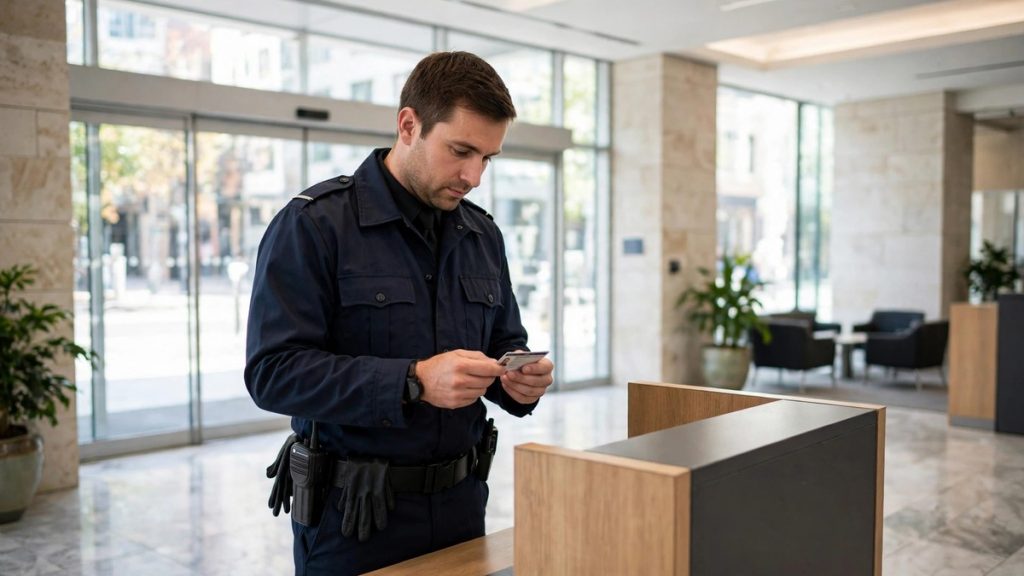
Security Guard Licence Ontario: How to Get One
A security guard licence Ontario employers require is issued by ServiceOntario after a 40-hour course, a ministry test, and a police background check. The licence fee is $80, the test costs $40 plus HST, and an online application takes up to 15 days. This guide walks through each step in order, with the fees and timelines as they stand.
Key Takeaways
– You must hold a valid licence to work as a security guard in Ontario. Working without one is not an option — employers cannot legally put you on post unlicensed.
– The route has three steps: a basic training course of at least 40 hours including emergency first aid and CPR, the ministry test, and a licence application to ServiceOntario.
– The test has 60 multiple-choice questions, a 75-minute limit, and a 62% pass mark. The fee is $40.00 plus HST ($45.20) per attempt, from 1 November 2026.
– Every application must include a Criminal Record and Judicial Matters Check issued within the last 6 months. The licence fee is $80.
– A correct online application takes up to 15 calendar days to process; mail takes up to 30. The licence is digital — you receive it by email and carry a digital or printed copy.
Security guard licence Ontario: who needs one, and who can get one
A security guard licence is a provincial licence, issued by ServiceOntario on behalf of Ontario’s Ministry of the Solicitor General, that authorizes you to work as a security guard in Ontario. You must have a valid licence to work as a security guard, a private investigator, or both. The licence belongs to you, not to your employer — it is your responsibility to apply for it, renew it, and keep it valid, and you carry a digital version or a printed copy at all times while working, ready to show on request.
To be eligible, you must be at least 18 years old, legally entitled to work in Canada, and able to hold a licence with a clean criminal record under the province’s rules. The law behind the licence is the Private Security and Investigative Services Act, 2005, and the ministry can refuse or revoke a licence based on criminal history. If you have a record, check the ministry’s rules before spending money on training — a record does not automatically disqualify you in every case, but some convictions do, and finding out after the course is an expensive lesson.
One important exemption: if you hold a valid security guard licence from another Canadian province or territory, you do not need to complete Ontario’s mandatory training and testing. You still need an Ontario licence, but you can apply through the out-of-province route. Contact the ministry’s Private Security and Investigative Services Branch for the current out-of-province process before you pay for training you may not need.
Note what the licence is not. A security guard licence is not police authority. Guards observe, report, deter, and protect people and property within the law — they do not hold police powers, and the training covers the legal limits on what a guard can and cannot do, including the limits on the use of force and on detaining a person. Employers, clients, and the public all expect guards to know those limits cold.
Step 1: the 40-hour basic training course
Every new security guard must finish a basic training course before the test. The course must be at least 40 hours long, including certification in emergency first aid and CPR. If you already hold a valid emergency first aid and CPR certificate from an approved provider, the training requirement drops to 33.5 hours — confirm your certificate qualifies before you enrol, because not every first aid certificate counts.
The course covers the Ontario training syllabus for security guards: the role of a security guard, legal authorities and limits, effective communication, sensitivity training, use of force theory, emergency response, health and safety, and report writing. Training providers set their own prices and schedules — ontario.ca publishes no course price, and prices vary widely between providers, so compare at least three. Courses run online, in person, or mixed, over days or weeks depending on the provider. Choose a provider from the list ontario.ca publishes; training from an unlisted provider does not count, and the ministry will not accept it.
When you finish, the provider issues a Training Completion Number (TCN). Guard that number — you need it to book the test, and you will need it again for the licence application. If you lose it, contact your training provider, not the ministry. The TCN is proof you completed the course, and no TCN means no test booking. Beware of any provider selling a “guaranteed licence” or a TCN without training — licences come only from ServiceOntario after the test, and our guide to job scams in Canada lists the warning signs.
Step 2: the ministry test
Book the test online with your TCN. You can take it online or at a DriveTest centre. The test has 60 multiple-choice questions, a 75-minute time limit, and a pass mark of 62% — 37 correct answers out of 60. The questions follow the training syllabus, so the course material is the study material. Read the ministry’s security guard study guide as well; it is the document the test is built from.
The test fee is $40.00 plus 13% HST, $45.20 in all, per attempt, from 1 November 2026. Older guides quote the previous fee of $35 plus HST ($39.55) — that figure is out of date. Fees change, so confirm the current test fee on the testing provider’s site when you book. If you fail, you can rebook and pay again; there is no limit in the published rules on attempts, but each attempt costs the full fee, so prepare properly the first time.
Two booking rules catch people out. First, your name on the test booking must match your identification exactly — a mismatch can bar you from the test sitting. Second, if you take the test online, you need a quiet room, a working webcam, and a stable connection, and the proctoring rules are strict. If your home setup is unreliable, book a DriveTest centre instead. A failed sitting because of a dropped connection still costs the fee.
Step 3: the police check and the licence application
Since 18 February 2024, every security guard licence application in Ontario must include a Criminal Record and Judicial Matters Check (CRJMC) completed by a police service. The check must have been issued within the last 6 months when you apply. Get the check from your local police service — processing times vary by service, from days to weeks, so start it while you are still in training, not after you pass the test. A check older than 6 months will be rejected, and you will have to get a new one.
Apply to ServiceOntario, online or by mail. Online applications can only be submitted by people who receive and submit an original, unaltered, digital PDF of their CRJMC — if your police service issues only a paper check, you apply by mail. A correctly completed online application can take up to 15 calendar days to process and approve; a mail application can take up to 30. You will need an Ontario.ca Login, your TCN, two pieces of identification from ServiceOntario’s list (which includes a Permanent Resident Card, a Confirmation of Permanent Residence, a Canadian passport or citizenship certificate, and a valid work or study permit), a guarantor form, a photo, and the $80 licence fee, paid by Visa or Mastercard online. The fee is not refundable. ServiceOntario does not accept licence applications at its service counters — online or mail only.
Once approved, you receive your digital licence by email. No physical licence is issued, but you can download or print the digital licence by signing into your Ontario.ca Login. The licence runs until two birthdays after it is issued — in practice, about two years — and you renew through the same ServiceOntario process. A dual licence covering both security guard and private investigator work costs $160. If ServiceOntario asks you for more information, respond within 90 calendar days or your application may be closed and your fee lost.
What the job pays, and what comes after the licence
Job Bank lists security guards under NOC 64410, security guards and related security service occupations. Check the Job Bank wage tool for the current figures for your region before you accept an offer — our guide to searching and applying on Job Bank shows how. Guard pay varies by employer, site, shift, and whether the role is in-house or contract. Contract security companies post most entry-level guard jobs, and the largest employers hire through their own careers pages. GardaWorld, one of Canada’s largest security employers, posts guard and screening roles on its careers site.
The licence opens more than static guard posts. With experience, guards move into mobile patrol, concierge security in residential and commercial buildings, loss prevention in retail — see our guide to retail sales jobs for the shop roles loss-prevention guards work alongside — event security, and supervisory roles. Guards also work construction sites; our guide to construction labourer jobs covers the site work and tickets those roles involve. Mobile patrol needs a valid driver’s licence and a clean driving record — our guide to delivery driver jobs in Canada covers licence classes and driving-record checks that apply to patrol driving too. Each step usually needs the same base licence plus site-specific training from the employer. Some roles need additional tickets — first aid at a higher level, a driver’s licence for mobile patrol, or WHMIS and site safety training. Ask at the interview what tickets the site values, and collect them one at a time.
Keep your licence in good standing. Report a change of address to ServiceOntario, renew before expiry, and understand that the ministry can suspend or revoke a licence for misconduct or criminal convictions. A licence is a professional credential — treat it like one, and it will carry you through years of steady work.
Frequently Asked Questions
How long does it take to get a security guard licence in Ontario?
Most people finish in two to five weeks: the 40-hour course (days to weeks depending on the provider), the test booking, the police check (days to weeks depending on your police service), and up to 15 calendar days for a correct online application. Start the police check during training to avoid dead time after the test.
How much does an Ontario security guard licence cost?
The licence fee is $80. The ministry test costs $40.00 plus HST ($45.20) per attempt from 1 November 2026. The 40-hour course price is set by each training provider and varies widely, and the police check fee is set by your police service. Confirm all fees on the official sites when you book, because they change.
Can newcomers get a security guard licence in Ontario?
Yes, if you are 18 or older, legally entitled to work in Canada, and able to hold a licence with a clean criminal record. ServiceOntario’s identification list includes a Permanent Resident Card, a Confirmation of Permanent Residence, and a valid work or study permit. You must complete the same training, test, and police check as any other applicant.
Do I need to renew my Ontario security guard licence?
Yes. The licence runs until two birthdays after it is issued — about two years — and you renew through ServiceOntario, online or by mail, with the same $80 fee. Keep your address current with ServiceOntario, and renew before the licence expires so there is no gap in your authorization to work.
Sources
- Government of Ontario, Security guard or private investigator licence (individuals): https://www.ontario.ca/page/security-guard-or-private-investigator-licence-individuals
- Government of Canada, Job Bank: https://www.jobbank.gc.ca/
Never pay anyone for a job, LMIA or a visa. Real Canadian employers never charge workers a fee.




Leave a Reply
You must be logged in to post a comment.