
Construction Labourer Jobs in Canada: Full Guide
The construction labourer jobs Canada builders hire for most often put you on residential, commercial and road projects, moving materials, helping tradespeople and keeping the site clean and safe. No formal education is usually required, the work is physical and outdoors in all weather, and pay varies a lot by province and project.
Key Takeaways
– Construction labourers sit in NOC 75110, construction trades helpers and labourers, a group Job Bank describes as usually needing short-term work demonstration and no formal education.
– Job Bank wage data quoted by the Government of Newfoundland and Labrador showed a national low of $19.00, a median of $25.10 and a high of $39.92 an hour.
– In Ontario, workers on construction projects who use fall protection must complete approved working at heights training before they use it, and the training is valid for 3 years.
– WHMIS education and training is an employer duty across Canada for workers who handle or may be exposed to hazardous products.
– Search Job Bank by NOC 75110 and check large builders’ own careers pages, and read every posting for the tickets, hours and wage it actually offers.
Construction labourer jobs Canada: what the work involves
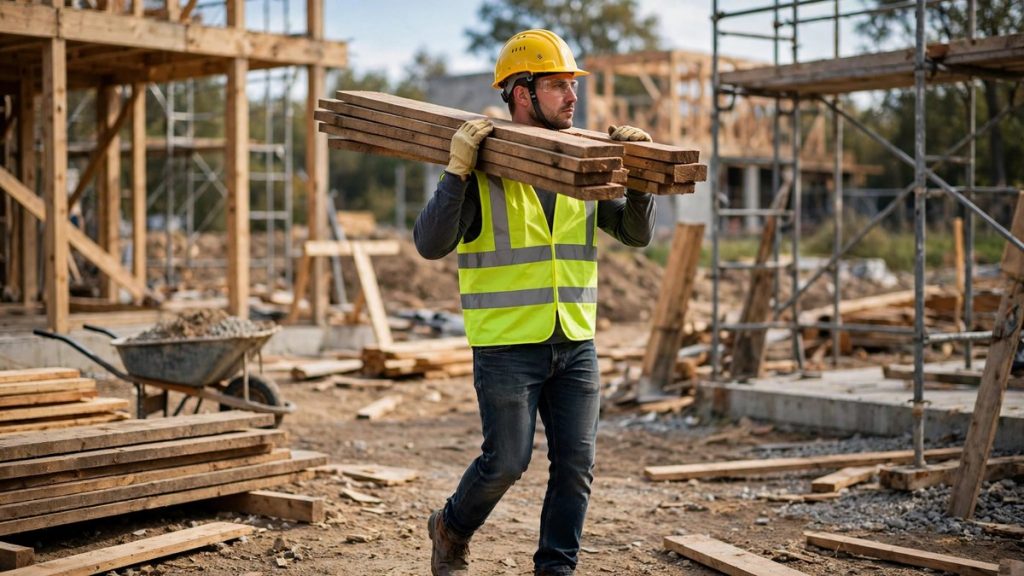
A construction labourer is a worker who assists skilled tradespeople and performs labouring activities at construction sites, in quarries and in surface mines. That is the core of the NOC 75110 occupation group. Duties that show up most often include loading and unloading materials and moving them to work areas; erecting and dismantling concrete forms, scaffolding, ramps, catwalks, shoring and barricades; mixing, pouring and spreading concrete and asphalt; assisting carpenters, bricklayers, cement finishers, roofers and glaziers; levelling earth and digging trenches; cleaning up rubble and debris; operating basic tools under supervision; and directing traffic near a work zone where required.
Notice what is not on that list: designing the work, signing off on it, or working unsupervised on a licensed trade’s tasks. A labourer supports the trades and the project, and that boundary protects you. If a supervisor asks you to do work you have not been trained for — operating a crane, wiring a panel, entering a confined space — stop and say so. Most labourers start early, often 6:30 or 7:00 a.m., with a toolbox talk on the day’s tasks and hazards before assignments are handed out. Weather is part of the job: rain turns a site to mud, winter in Edmonton or Winnipeg means layered clothing and short daylight, and summer in southern Ontario means heat and dust. Good boots, gloves that fit, and water are not luxuries. When you apply, name specific experience that fits the site: “six months carrying and placing rebar on a high-rise in Mississauga” tells a hiring manager far more than “construction experience.”
Tickets and training: what helps, and what the law requires
Separate three things: training the law requires, training an employer requires, and training that simply makes you easier to hire. Mixing them up is how job seekers waste money.
Working at heights training in Ontario is a legal requirement for a defined group. Ontario states that workers on construction projects who use fall protection devices must take a working at heights training program, approved by the Chief Prevention Officer and delivered by an approved provider, before they can use fall protection. It covers workers who must use a travel restraint system, a fall restricting system, a fall arrest system, a safety net, a work belt, or a safety belt. The training is valid for 3 years, after which a refresher keeps it valid for another 3 years, and workers do not need to repeat it when they change employers while it is still valid. The ministry warns about fraudulent providers who take fees and issue cards without valid training, so use only an approved provider and check the ministry’s lists before you pay anyone. Outside Ontario, the rules differ by province and territory, so check the regulator where you will work.
WHMIS works differently. The Canadian Centre for Occupational Health and Safety explains that education and training are two parts: education covers general, portable knowledge such as hazard classes, labels and safety data sheets, while training covers site- and job-specific procedures for storage, handling, use, disposal, emergencies and spills. All Canadian jurisdictions require employers to develop, implement and maintain a WHMIS education and training program, and workers who work with or may be exposed to hazardous products must receive product-specific training. A general WHMIS course you took online does not replace the site-specific half your employer owes you. Other tickets appear by site and province: first aid and CPR, flagger training on road work, and forklift or elevated work platform tickets where the work calls for them. Read the posting, get the ticket it names from a recognized provider, and keep a note of each expiry date. Many postings also ask for a valid driver’s licence and reliable transport, because sites move and transit rarely reaches a new subdivision at 6:30 in the morning.
Wages: what the official figures show
Construction labourer pay varies more than most entry-level work, because the group mixes short-term site helpers with experienced crew members on specialized projects. The Government of Newfoundland and Labrador’s labour market page for NOC 75110, quoting Job Bank, gives the national picture:
| Area | Low ($/hour) | Median ($/hour) | High ($/hour) |
|---|---|---|---|
| Canada | 19.00 | 25.10 | 39.92 |
| Newfoundland and Labrador | 16.59 | 22.00 | 32.00 |
Source: Government of Newfoundland and Labrador labour market information for construction trades helpers and labourers (NOC 75110), citing Job Bank, Government of Canada.
The national median of $25.10 an hour is an anchor, not a promise. Your offer depends on the province, the city, the project type, whether the job is unionized, your experience, and the tickets you hold. Run the numbers on any offer. At $25.10 an hour, 40 hours a week is $1,004 a week before tax, or $52,208 over 52 weeks at that pace. At $19.00 an hour, the same schedule is $760 a week, or $39,520 over 52 weeks. Construction work is seasonal in much of Canada, and layoffs between projects are common, so a full 52 weeks at steady hours is not guaranteed. Ask about the expected project length, the chance of moving to the next project with the same employer, and how overtime is paid. On unionized projects, pay and overtime rules sit in a collective agreement; on non-union projects, the employer sets the rate and the posting should state it. Compare the offer with Job Bank’s wage report for your region, keep the offer in writing, and raise any pay difference in your first pay period.
Safety expectations: what a good site looks like
Construction carries real hazards: falls, moving equipment, falling objects, electrical sources, trenches, dust, and noise. A good site manages them visibly. Expect a site orientation on your first day, protective equipment requirements spelled out — hard hat, high-visibility vest, safety boots, eye and hearing protection where needed — and a supervisor who answers safety questions without impatience. Your part is straightforward. Wear the protective equipment the site requires, every time, even for a five-minute task. Follow the rules for ladders, scaffolds and fall protection. Keep your work area clean; tripping hazards injure more labourers than dramatic accidents do. Report hazards the moment you see them, and report every injury and near-miss, however small. Near-miss reports are how a site fixes a problem before it injures the next person.
Fatigue is a safety issue too. Long days, early starts, and physical work add up, and tired workers make mistakes with tools and equipment. If you are too tired to work safely, say so. One habit marks out workers who last in this trade: they watch the experienced people. Watch how a carpenter sets up a saw, how a crane crew signals a lift, how a flagger positions themselves so drivers can see them. Ask why, when the moment allows. Most tradespeople will teach a labourer who shows up on time, works hard, and asks sensible questions. That teaching is the real training in construction, and it costs you nothing but attention.
How to find construction labourer work
Job Bank is your starting point: search by NOC 75110, filter by location and date posted, and check wages beside the postings. Our step-by-step guide to how to use Job Bank Canada shows the filters that matter, including the filter for jobs open to international candidates if you are applying from outside Canada. Search more than one title: “construction labourer,” “general labourer,” “construction helper,” “demolition labourer,” “concrete labourer,” and “road construction labourer” all surface different postings. Large builders post on their own careers pages, worth checking weekly. PCL Construction, EllisDon and Aecon are three national builders on our verified employer watch list, each with a Canadian careers portal, and their postings usually name the project location, shift pattern, and tickets required. Smaller contractors hire through Job Bank, word of mouth, and signs at the site gate. If you pass a site every day, note the contractor’s name from the site sign and check their website.
Staffing agencies place labourers on short-term and project work, and that route can build experience fast. The agency must not charge you a fee for finding you work. Keep copies of every agreement you sign, and confirm the wage, hours and project location in writing before your first shift. If you are new to Canada, lead with what you have done, in concrete terms. “Two years mixing and pouring concrete on residential sites” travels across borders. “Hard worker” does not. Our guide to getting hired with no Canadian experience shows how to frame overseas site experience so a Canadian hiring manager can judge it fairly. Many tradespeople started as labourers, and labouring beside carpenters, electricians and welders shows you which trade fits you. If one catches your interest, check your province’s apprenticeship authority for the entry requirements, since trades are regulated provincially.
LMIA and work permits: a short, honest note
Construction labourer postings do not automatically support a work permit. If you are outside Canada and do not hold a valid work permit, apply only to postings from employers who are open to recruiting international candidates or temporary foreign workers, and use Job Bank’s Temporary Foreign Workers page to find employers who have obtained or applied for an LMIA. Treat “LMIA requested” and “LMIA approved” as different statuses, because they are. Our guide to LMIA jobs in Canada explains the process in full. Never pay anyone for a job or an LMIA, and never hand over your passport or original documents to a recruiter you have not verified through official channels.
Frequently Asked Questions
Do I need a diploma to work as a construction labourer in Canada?
No. Job Bank describes construction trades helpers and labourers (NOC 75110) as work that usually needs short-term work demonstration and no formal education. Individual postings may ask for a high school diploma, a driver’s licence, or specific tickets such as working at heights training in Ontario, so read each posting.
How much do construction labourers earn in Canada?
National Job Bank wage data quoted by the Government of Newfoundland and Labrador showed a low of $19.00, a median of $25.10 and a high of $39.92 an hour for NOC 75110. Your offer depends on the province, project type, union status, experience and tickets, and on overtime and premiums. Compare any offer with the Job Bank wage report for your region.
Do I need working at heights training to be a construction labourer in Ontario?
You need it if you work on a construction project in Ontario and must use fall protection, such as a fall arrest system or a travel restraint system. Ontario requires an approved program from an approved provider, completed before you use fall protection, and the training is valid for 3 years. Many Ontario postings list it anyway, so holding a valid card widens the roles you can take.
Is WHMIS training required for construction workers?
WHMIS education and training is an employer duty in every Canadian jurisdiction for workers who handle or may be exposed to hazardous products, with two parts: general education about hazards, labels and safety data sheets, plus site- and job-specific training on the products and procedures in your workplace. A general course does not replace the site-specific training your employer must give you.
Sources
- Government of Newfoundland and Labrador, Labour Market Information: Construction trades helpers and labourers (NOC 75110): https://www.gov.nl.ca/labourmarketinformation/career/construction-trades-helpers-and-labourers/
- Government of Ontario, Training for working at heights: https://www.ontario.ca/page/training-working-heights
- Canadian Centre for Occupational Health and Safety, WHMIS – Education and Training: https://www.ccohs.ca/oshanswers/chemicals/whmis_ghs/CCOHS_education_training.pdf
- Job Bank, Temporary Foreign Workers: https://www.jobbank.gc.ca/temporary-foreign-workers
- PCL Construction careers (Canada): https://careers.pcl.com/search/?optionsFacetsDD_country=CA&locale=en_US&optionsFacetsDD_department=Professional&utm_source=CorpSite&utm_campaign=Canada-Professionals-AllOpenings
- Aecon careers: https://www.aecon.com/join-our-team/careers
- EllisDon job board: https://recruiting.ultipro.ca/ELL5000/JobBoard/fa7dd324-0b16-f8cb-f544-f46b499e5db7/?q=&o=postedDateDesc
Never pay anyone for a job, LMIA or a visa. Real Canadian employers never charge workers a fee.




[…] work adds heights, confined spaces and coordination with other trades, and our guide to construction labourer jobs in Canada describes the site conditions welders share with the rest of the […]
[…] check union joint apprenticeship programs, and ask at every site contact you have. Our guide to construction labourer jobs in Canada covers the site roles that put you near electrical crews and build the safety tickets and […]
[…] or team work you have done: farm work, moving work, stock work, construction labour. Our guide to construction labourer jobs in Canada covers site work that builds the same habits hiring managers look for. The point is to show a […]
[…] resources production and fishing show a very good outlook. Construction trades vary; our guide to construction labourer jobs covers the entry roles, the tickets, and how site hiring works. If you are a tradesperson, the path […]