
How to Get a SIN Number in Canada: Full Guide
Learning how to get SIN number Canada newcomers need starts with one fact: the application is free, and you can apply online, in person, or by mail. A Social Insurance Number is the nine-digit number you need to work, get paid, and pay taxes. This guide covers the documents, the three routes, and the rules for temporary residents.
Key Takeaways
– A SIN is a 9-digit number issued by Service Canada. You need one to work legally, get paid, pay taxes, and access programs like Employment Insurance and the Canada Pension Plan.
– Applying is free through all three routes. Anyone who asks you to pay for a SIN is running a scam.
– You need one primary document proving your status, plus one secondary document confirming your identity if you are an adult.
– In person, you usually get your SIN during the visit. Online applications take about five business days, and mail about twenty.
– Temporary residents get a SIN starting with 9 that expires on the same date as their work permit, study permit, or visitor record.
How to get SIN number Canada: what it is and who needs one
A Social Insurance Number is a 9-digit number the Government of Canada issues so employers, the tax system, and benefit programs can link your earnings and contributions to you. Service Canada, part of Employment and Social Development Canada, is the office that issues it. You need a SIN to work in Canada, to be paid, to file income taxes, and to access government programs such as Employment Insurance and the Canada Pension Plan.
Every employee must obtain a SIN and give it to their employer. Your employer must get your SIN within three days of your start date, and an incorrect SIN can affect your future Canada Pension Plan benefits if your record of earnings is wrong. That is why getting the number right, and giving it promptly, matters from the first day of work. If you are starting a job and have applied but not yet received your number, tell your employer you have applied — you can start work while the application is being processed, but you must provide the number as soon as you receive it.
There is no SIN card any more. The government stopped issuing plastic SIN cards in 2014. Instead, you receive a Confirmation of Social Insurance Number letter — printed during an in-person visit, mailed to you, or available as a digital letter through My Service Canada Account. Keep that letter safe, and memorize the number. The letter is the only proof you get, and replacing it takes a separate request. Getting your SIN is the first task in our newcomer first 30 days plan, because almost everything else connects to it. With your SIN in hand, you can start applying — our guide to searching and applying on Job Bank shows the filters that save the most time.
The documents: one primary, one secondary
You need one primary identity document that proves your legal status in Canada, and if you are an adult, one secondary document that confirms your legal name and date of birth. If your current legal name differs from the name on your documents — for example, after a marriage — bring a supporting document showing both names, such as a marriage certificate. Documents not in English or French need a certified translation. Bring originals for in-person and mail applications: photocopies are not accepted in person, and mailed originals are returned to you by mail.
The primary document depends on your status:
- Canadian citizens: a birth certificate from the province or territory of birth, a Certificate of Canadian Citizenship, or a Registration of Birth Abroad issued before 1977.
- Permanent residents: a Permanent Resident Card, or a Confirmation of Permanent Residence (COPR) within one year of becoming a permanent resident, along with a valid foreign passport.
- Temporary residents: a valid work permit, study permit, or visitor record from IRCC that authorizes you to work. The permit must show you are allowed to work — for students, the study permit must carry a condition allowing employment. Email messages from IRCC are not accepted as proof.
The secondary document is a government-issued photo ID confirming your legal name and date of birth: a valid passport (Canadian or foreign), a provincial or territorial photo ID card, or a Canadian driver’s licence. Your passport usually does this job, which is why most newcomers apply with their immigration document plus their passport and nothing else.
One detail that trips people up: if your study permit does not carry a condition allowing you to work off campus, you must request an amendment to your study permit before Service Canada can issue you a SIN. Check the conditions printed on your permit before you apply. Our guide to international student work rules explains the permit conditions in full.
The three routes: in person, online, or by mail
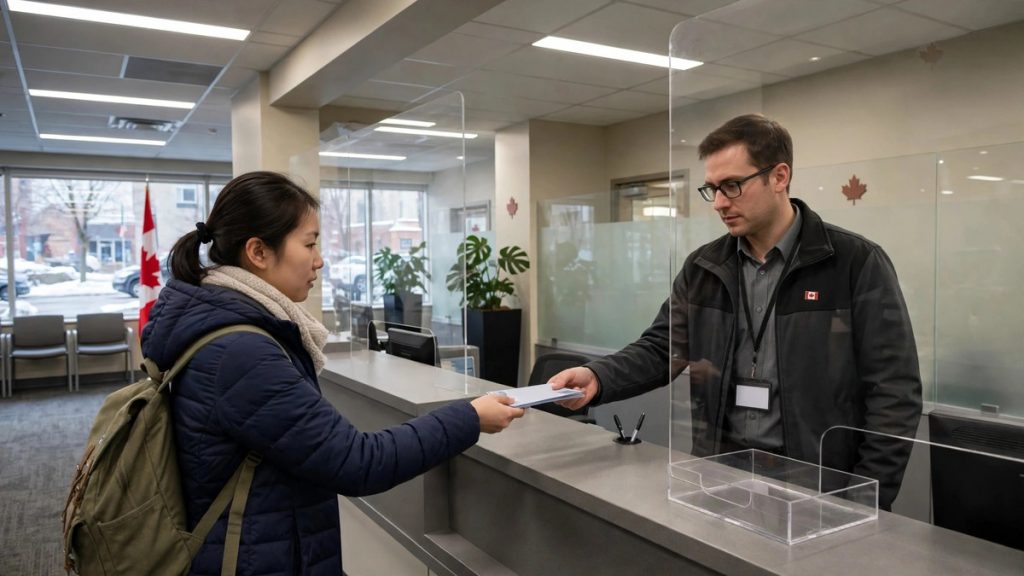
In person is the fastest route and the most common choice for newcomers. Go to a Service Canada Centre with your original documents. If everything is in order, you receive your SIN during the visit and keep your documents. You can request an appointment through Service Canada’s online service request form, or visit a centre directly — check the office locator for hours first, because they vary. In person is the right choice if you need the number immediately to finalize a job offer or start payroll.
Online suits people who cannot easily reach an office. You upload clear digital copies of both sides of your documents, with the borders visible, through the Service Canada online application. Online applications are usually processed within about five business days, and you can view your number through My Service Canada Account once it is processed. Service Canada does not publish a fixed service standard for online applications, so treat five days as typical, not promised. If you make a mistake or leave out a document, you cannot edit the application — you must submit a new one with all documents, so check everything before you send it.
By mail is the slowest route and is meant for people who live far from a Service Canada office, face extenuating circumstances, or are applying from outside Canada. You send the application form and your original documents to the Social Insurance Registration Office in Bathurst, New Brunswick (PO Box 7000, Bathurst NB E2A 4T1). Your originals are returned to you by mail. Mail applications take about 20 business days. Do not choose mail if you need the number quickly, and do not send photocopies — only originals are accepted.
Whichever route you use, the application is free. There is no fee to apply, to update the expiry date on a temporary SIN, or to request a confirmation letter. Service Canada cannot give you your SIN over the phone. If more than 10 business days have passed since an online application, or more than 25 since a mail application, contact the SIN Program to check.
Temporary SINs: the 9-series rules
SINs issued to temporary residents always start with 9. Your temporary SIN expires on the same date as the IRCC document that authorizes you to work — your work permit, study permit, or visitor record. When you receive a new permit, you must apply to update your SIN record with the new expiry date. The number itself stays the same; only the expiry date changes.
If you applied to extend your permit before it expired and you hold maintained status, you can keep working with an expired SIN until IRCC decides your application. Your employer must verify the work authorization and document expiry of employees whose SIN starts with 9, so keep your permit documents current and show your employer the new document when it arrives. Our guide to work permits vs job offers explains maintained status and permit conditions in full. When you become a permanent resident, apply for a new, permanent SIN — the 9-series number is replaced, and your earnings history follows you through the update.
Students have one extra wrinkle. Your study permit must carry a condition allowing off-campus work before Service Canada will issue a SIN for that purpose. The condition wording on newer permits reads “May work 24 hours per week off campus or full-time during regular breaks” — if your permit carries older wording, or no work condition at all, request an amendment from IRCC first. Do not start working before your study program begins: IRCC states plainly that you can only start working when your program starts.
Protecting your SIN
Your SIN is confidential, and protecting it is your responsibility. Only a small list of organizations legitimately need it: your employer (for payroll and taxes), the Canada Revenue Agency, banks and financial institutions (for tax reporting on interest and investments), and federal and provincial government programs. A landlord, a phone company, a store, or a stranger on social media does not need your SIN. If someone asks and you are unsure, ask why they need it, how they will store it, and what happens if you refuse — and walk away if the answers are vague.
Never share your SIN by email, text, or social media message, and never give it to someone who contacts you by phone claiming to be from the government. Service Canada and the CRA do not ask for your SIN by phone or email out of the blue. Our guide to job scams in Canada lists the warning signs these approaches share. If you lose your SIN or forget the number, you can request a confirmation letter from Service Canada — you will need to prove your identity, and the process is straightforward if your documents are in order.
A new SIN is rare and hard to get. The SIN Program can only issue one with proof that your number was used to commit fraud, you must apply in person at a Service Canada Centre, and approval is not guaranteed. That is why protecting the number you have matters more than any recovery process. Keep the confirmation letter somewhere safe, do not carry it in your wallet, and do not post it anywhere — not even a photo of it.
Frequently Asked Questions
How long does it take to get a SIN in Canada?
In person at a Service Canada Centre, you usually receive your SIN during the visit if your documents are in order. Online applications are usually processed within about five business days, and mail applications within about 20 business days. Service Canada does not publish a fixed service standard, so check canada.ca for the current timeline before you apply.
Is a SIN free in Canada?
Yes. Applying for a SIN is completely free through all three routes — online, in person, and by mail — and there is no fee to update a temporary SIN or request a confirmation letter. Anyone who asks you to pay for a SIN, or offers to “arrange” one for a fee, is running a scam.
What documents do I need to get a SIN as a newcomer?
You need one primary document proving your status (PR card or COPR for permanent residents; a work or study permit authorizing employment for temporary residents) and, if you are an adult, one secondary photo ID confirming your legal name and date of birth, such as a passport. Bring originals for in-person applications, and add a supporting document if your name has changed.
Does a temporary SIN expire?
Yes. A SIN starting with 9 expires on the same date as the work permit, study permit, or visitor record that authorizes you to work. When you get a new permit, update your SIN record with the new expiry date. If you applied to extend your permit before it expired, you can keep working under maintained status until IRCC decides.
Sources
- Employment and Social Development Canada, Social Insurance Number: https://www.canada.ca/en/employment-social-development/services/sin.html
- Employment and Social Development Canada, SIN for temporary residents in Canada: https://www.canada.ca/en/employment-social-development/services/sin/temporary-residents.html
- Canada Revenue Agency, Get the social insurance number (SIN) from the employee: https://www.canada.ca/en/revenue-agency/services/tax/businesses/topics/payroll/set-up-new-employee/social-insurance-number.html
- Immigration, Refugees and Citizenship Canada, Work off campus as an international student: https://ircc.canada.ca/English/study/work-offcampus.asp
Never pay anyone for a job, LMIA or a visa. Real Canadian employers never charge workers a fee.




[…] In person, with the right documents, you usually leave with your number the same day. Our guide on how to get a SIN number in Canada walks through the documents and the three routes. Do this in your first few days, because almost […]
[…] your Social Insurance Number, open a bank account, and register with Manitoba Start. Our guide on how to apply for a SIN walks through the process. Write a one-page Canadian-style resume — no photo, no age, no marital […]